Trench Collapses: OSHA Violations and Your Right to Maximum Compensation
A trench collapse is one of the few construction accidents that can turn fatal in seconds. A single cubic yard of soil weighs as much as a small car, and when a wall gives way, it does not bury a worker gradually — it crushes the chest and traps the body before anyone can react. For those who survive, the injuries are often severe: crushed limbs, spinal damage, internal trauma, and long recoveries that drain both savings and hope.
What many injured workers are never told is that trench collapses are rarely true accidents. They are almost always the result of a known, preventable safety failure — and that distinction can dramatically change what a recovery looks like.
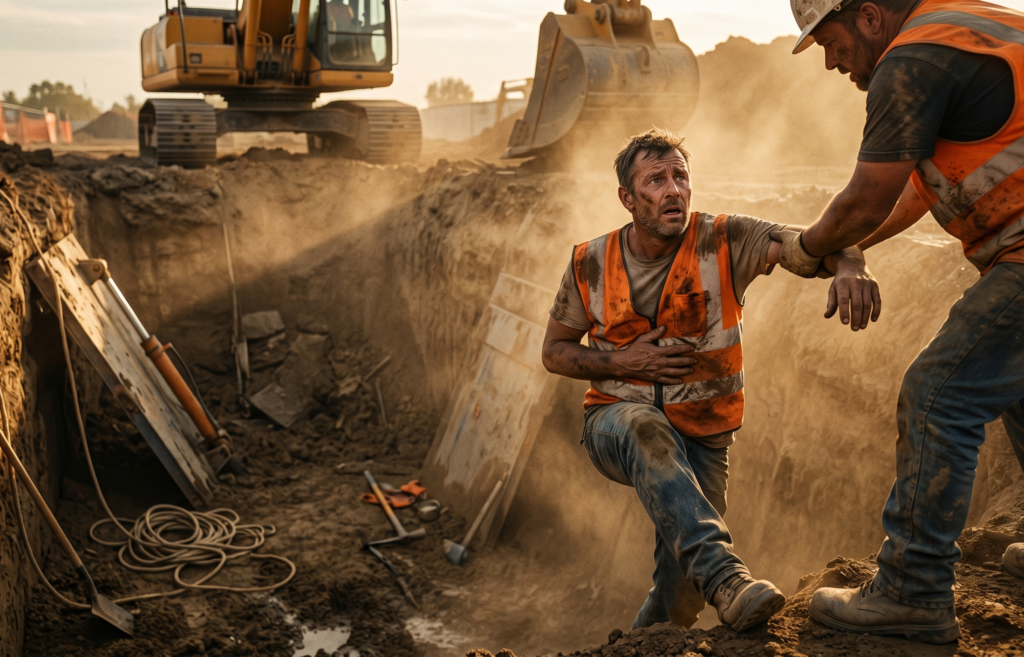
Why a Trench Collapse Is Almost Never “Just an Accident”
Excavation safety is not a gray area. The hazards of unprotected trenches have been understood for decades, and the rules meant to prevent collapses are among the most specific in all of construction. When a wall caves in, it generally means a required protection was missing — not that fate intervened.
Federal standards generally require a protective system in any trench five feet deep or greater, and they require that a “competent person” inspect the excavation before workers enter and after any change in conditions, such as rain or vibration. When those steps are skipped to save time or money, the collapse that follows is the predictable result of a choice.
The point most workers miss: A trench collapse usually points to a documented safety violation. That violation does not just explain the accident — it can become the single most powerful piece of evidence in pursuing full compensation.
The OSHA Standards That Should Have Protected You
Excavation safety generally rests on three recognized methods of protecting workers from a cave-in. Standard guidelines suggest that at least one of these must be in place once a trench reaches the regulated depth:
- Sloping or benching — cutting the trench walls back at an angle so the soil cannot shear off and fall inward.
- Shoring — installing hydraulic or timber supports that brace the walls and hold them in place.
- Shielding — placing a protective “trench box” around workers so a collapse cannot reach them.
Alongside protection systems, the standards address safe access, spoil pile placement (keeping excavated dirt back from the edge), and daily inspections. You can review the official federal excavation and trenching requirements directly through the U.S. Occupational Safety and Health Administration (OSHA), which publishes the standards responsible contractors are expected to follow.
| Common Trench Hazard | What the Standard Generally Expects |
|---|---|
| Trench 5 ft or deeper, no protection | Sloping, shoring, or a trench box required |
| No safe way in or out | Ladder or ramp within 25 ft of workers |
| Dirt piled at the trench edge | Spoil kept back at least 2 ft from the edge |
| No inspection after rain | Competent person re-inspects before re-entry |
| Standing water in the trench | Special precautions or removal before entry |
How an OSHA Violation Strengthens Your Claim
Workers’ compensation is a no-fault system, which means you generally do not have to prove anyone was negligent to receive benefits. So why does an OSHA violation matter so much? Because a serious trench collapse often involves more than one path to recovery, and a documented violation can shape both.
On most excavation sites, your direct employer is only one of several companies present. A trench may involve a general contractor, an excavation subcontractor, an engineering firm, or an equipment supplier. When a company other than your employer contributed to the cave-in, a separate claim — often called a third-party claim — may exist outside the comp system. Unlike comp, that claim is based on fault, and a clear safety violation is exactly the kind of fault it turns on.
Insurer tactic to watch for: After a collapse, the trench is often backfilled and repaired within days, sometimes before any independent measurement of its depth or soil type is taken. Once the trench is gone, proving how it failed becomes far harder. Attorneys often emphasize how decisive those first days can be for preserving the evidence.
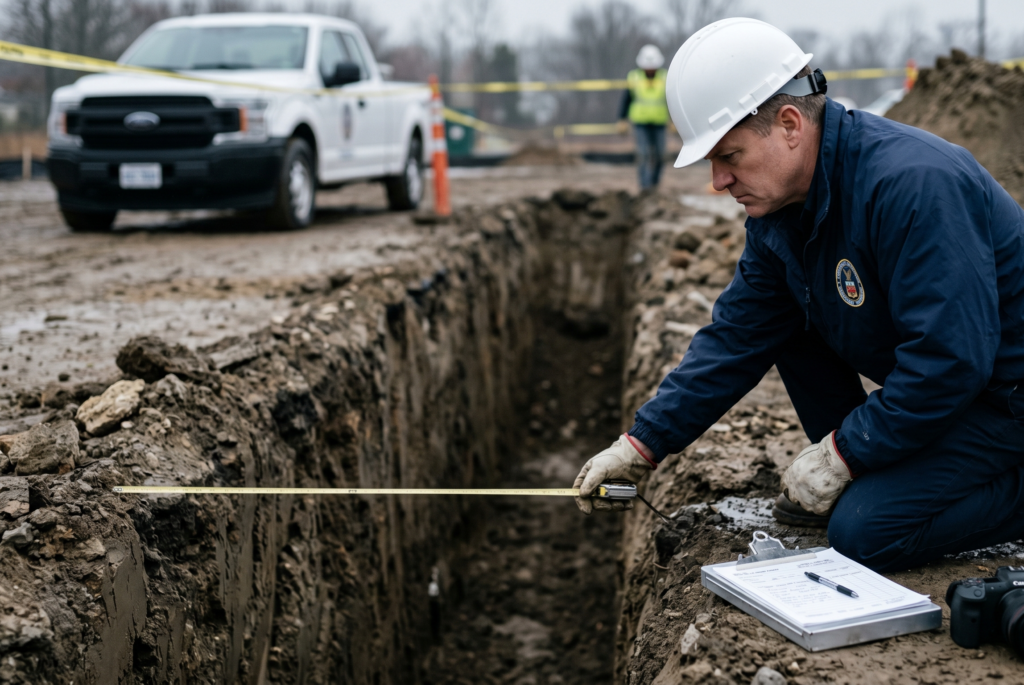
What Maximum Compensation Can Actually Include
For a catastrophic injury, the difference between standard comp benefits and full compensation can be enormous. Workers’ comp generally covers medical treatment and a portion of lost wages, but it typically does not pay for the full human cost of being crushed in a trench. Standard guidelines suggest that a complete recovery picture may involve several layers:
- Medical coverage for emergency care, surgeries, rehabilitation, and future treatment related to the injury.
- Wage replacement while you are unable to work, though comp usually pays only a percentage of your lost earnings.
- Permanent disability benefits when a trench injury causes lasting impairment.
- Third-party damages, which may reach full lost earnings and pain and suffering when a separate company’s negligence is shown.
Because these layers interact, the value comp leaves on the table is often exactly what a third-party claim is built to recover. For a broader walkthrough of how a construction injury moves from the first report to a full resolution, our complete workers’ compensation guide explains each stage in plain language.
Deadlines and State Rules That Change Everything
This is where strong claims quietly disappear. A workers’ comp claim and a third-party negligence claim run on completely different clocks. The deadline to report a comp injury may be measured in days, while the deadline to file a negligence claim — the statute of limitations — is generally measured in years, but varies dramatically from one state to the next.
State laws vary significantly. Reporting windows, statutes of limitations, and the rules on shared fault all change from state to state. In some states, any fault assigned to the worker can reduce recovery; in others, the rules are far more forgiving. Standard guidelines suggest confirming the specific deadlines that apply where the injury occurred, because a missed window generally cannot be reopened.
There is also the matter of the comp “lien.” When a third-party claim succeeds, the workers’ comp insurer that already paid benefits may be entitled to repayment from that recovery. How this affects your net result is highly state-specific, which is one reason these claims are usually evaluated together rather than separately.
Remember: A trench collapse can open two doors, not one. Workers’ comp addresses the immediate medical and wage support, while a third-party claim may address everything comp leaves behind. The safety violation that caused the cave-in often sits at the center of both, and state laws vary significantly.
See What Your Claim May Truly Be Worth
A trench collapse can leave you facing surgeries, lost income, and a recovery that comp checks barely touch — while the possibility of a larger claim built on a clear OSHA violation goes completely unexamined. Before you assume workers’ comp is the end of the story, it helps to understand the potential value and direction of your situation. Try the free, anonymous Benefits Estimator at HardHat Rights to get a clearer picture in minutes, with no names and no pressure. Start your free Benefits Estimator here and find out what your next step could look like.
Disclaimer: This website is for informational purposes only and does not constitute legal or medical advice. The content provided is not intended to be a substitute for professional medical advice, diagnosis, or treatment. Benefit estimates are approximations based on standard state formulas and do not account for your state’s specific caps or your individual circumstances. Always consult a licensed workers’ compensation attorney in your state for legal advice, and a qualified health provider regarding any medical conditions or treatment.