Permanent Partial Disability (PPD) Ratings Explained for Construction Workers
For many injured construction workers, the most important number in the entire claim is one they never see being decided: the Permanent Partial Disability rating, or PPD. It is the percentage a doctor assigns once an injury has healed as much as it ever will, and it often determines the size of the final check — sometimes the difference between a few thousand dollars and tens of thousands.
Yet the rating process is quiet, technical, and easy to influence. A low number written into a single medical report can quietly shrink an entire settlement. This article explains what a PPD rating actually measures, how it is normally calculated, and the points where the figure is most often pushed downward.

What a PPD Rating Actually Measures
Permanent Partial Disability applies when a work injury leaves lasting impairment but does not prevent a worker from doing any work at all. A back that no longer bends the way it did, a knee that gives out, a hand that lost grip strength after a crush injury — these are the kinds of permanent limitations a PPD rating is meant to capture.
Generally, in many states, the rating is expressed as a percentage of impairment. That percentage may be tied to a specific body part (a “scheduled” loss, such as an arm or a foot) or to the body as a whole (an “unscheduled” loss, such as a back or neck injury). The higher the percentage, the larger the benefit that flows from it.
Why this number controls the claim: Most permanent benefits are calculated by multiplying the impairment percentage by a set number of weeks and by the worker’s weekly compensation rate. Shaving even a few percentage points off the rating can erase thousands of dollars from the final payout.
When the Rating Is Assigned: Maximum Medical Improvement
A PPD rating is not given while a worker is still healing. It usually comes at a milestone doctors call Maximum Medical Improvement, or MMI — the point at which the condition is considered stable and unlikely to improve much further with treatment.
Reaching MMI does not mean the worker is “all better.” It means the body has recovered as much as it realistically will. Standard guidelines suggest the impairment is measured at this stage because only then can a doctor estimate what is truly permanent. Being declared at MMI is a significant turning point in a claim, because it often shifts the focus from medical treatment to the value of the permanent loss.
How the Rating Is Normally Calculated
The exact method varies, but the general structure most systems follow looks like this:
- The worker reaches Maximum Medical Improvement (MMI).
- A physician examines the injury and assigns an impairment percentage, frequently using a standardized reference such as the AMA Guides to the Evaluation of Permanent Impairment.
- That percentage is applied to a state-defined number of weeks for the affected body part or for the body as a whole.
- The result is multiplied by the worker’s weekly compensation rate to produce the benefit amount.
The dispute is rarely about the arithmetic. It is almost always about step 2 — the percentage itself, and who decides it.
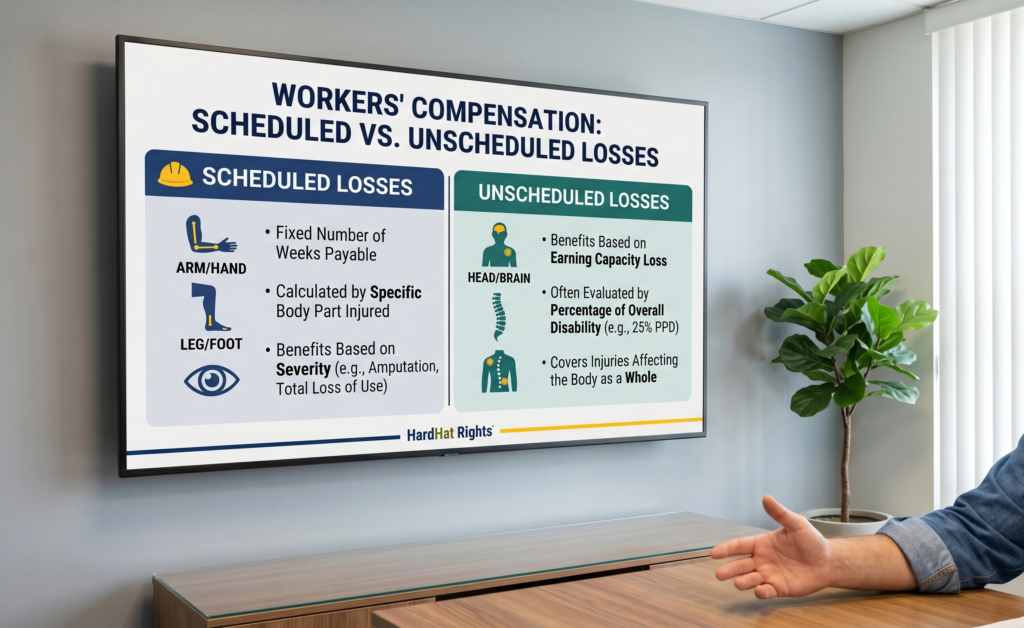
Scheduled vs. Unscheduled Losses
Understanding which category an injury falls into helps explain how the final number is built:
| Type of loss | What it covers | How it is generally valued |
|---|---|---|
| Scheduled | Specific body parts — arm, hand, finger, leg, foot, eye, hearing. | A fixed number of weeks is set by statute for each part; the impairment percentage is applied to that number. |
| Unscheduled | Injuries to the back, neck, spine, or other “whole body” systems. | Often based on a whole-person impairment rating and, in some states, on lost earning capacity. |
State laws vary significantly in how they treat these two categories. Some states value unscheduled injuries purely on the medical impairment percentage; others factor in age, education, and the worker’s ability to return to the same trade — which can matter enormously for someone whose body is their living.
How a Low Rating Quietly Costs You
Because so much money rides on a single percentage, the rating exam is a place where claims are often won or lost. The doctor who performs it is frequently chosen — and paid — by the insurance company, and not every impairment evaluation is generous.
Insurer tactic to watch for: A carrier may rely on a brief, one-time impairment exam by a physician it selects, then treat that low number as final. A treating doctor who has followed the injury for months may reach a very different rating. Attorneys often recommend comparing the two rather than accepting the insurer’s figure as the last word.
Other common ways a rating ends up too low include:
- The exam is rushed, and the worker downplays pain or limitations out of habit or pride.
- The doctor rates only the most obvious injury and overlooks secondary ones, such as a shoulder that was hurt compensating for a bad knee.
- An older edition of the impairment guide is used, or the wrong section is applied.
- Pain, range-of-motion loss, or nerve symptoms are measured on a single good day rather than across normal conditions.
For a broader walk-through of how the rating connects to the rest of the claims process, our complete guide to construction injury benefits covers each stage in plain language.
What Workers Often Do When a Rating Seems Too Low
There is no single correct path, and the right one depends heavily on the state. That said, attorneys often recommend a careful approach rather than signing off on the first number offered:
- Requesting a copy of the full impairment report and reading exactly how the percentage was reached.
- Asking the treating physician — the one who knows the injury best — whether they agree with the rating.
- Looking into whether the state allows a second opinion or independent rating when the figures conflict.
- Confirming that every injured body part, not just the main one, was evaluated.
Public agencies also publish a great deal of free background that helps workers understand their footing. The federal OSHA Workers’ Rights resource is one authoritative starting point for understanding the protections that apply on a jobsite, and many state workers’ compensation boards publish their own impairment schedules and dispute procedures.
The State-by-State Reality
It cannot be stressed enough: there is no national PPD system. State laws vary significantly regarding which impairment guide is used, how many weeks each body part is worth, whether earning capacity counts, and — critically — the deadlines to dispute a rating. In some states that window is measured in weeks, not months, and missing it can lock in a low number permanently.
Nothing here is legal or medical advice; it is general, informational background meant to help an injured worker ask sharper questions before accepting a figure that will shape the entire outcome of the claim.
See What Your Permanent Injury May Be Worth
Before accepting any impairment rating or settlement built on it, it helps to have an independent sense of where the numbers should realistically land. HardHat Rights offers a free, anonymous Benefits Estimator that walks through the same impairment and wage drivers insurers use, without asking for your name or signing you up for anything.
Try the free, anonymous Benefits Estimator at HardHat Rights to see how your rating compares to what a serious construction injury is typically worth — and walk into your next conversation with the carrier informed instead of shortchanged.
Disclaimer: This website is for informational purposes only and does not constitute legal or medical advice. The content provided is not intended to be a substitute for professional medical advice, diagnosis, or treatment. Benefit estimates are approximations based on standard state formulas and do not account for your state’s specific caps or your individual circumstances. Always consult a licensed workers’ compensation attorney in your state for legal advice, and a qualified health provider regarding any medical conditions or treatment.