Independent Contractor vs. Employee: The Misclassification Trap on Job Sites
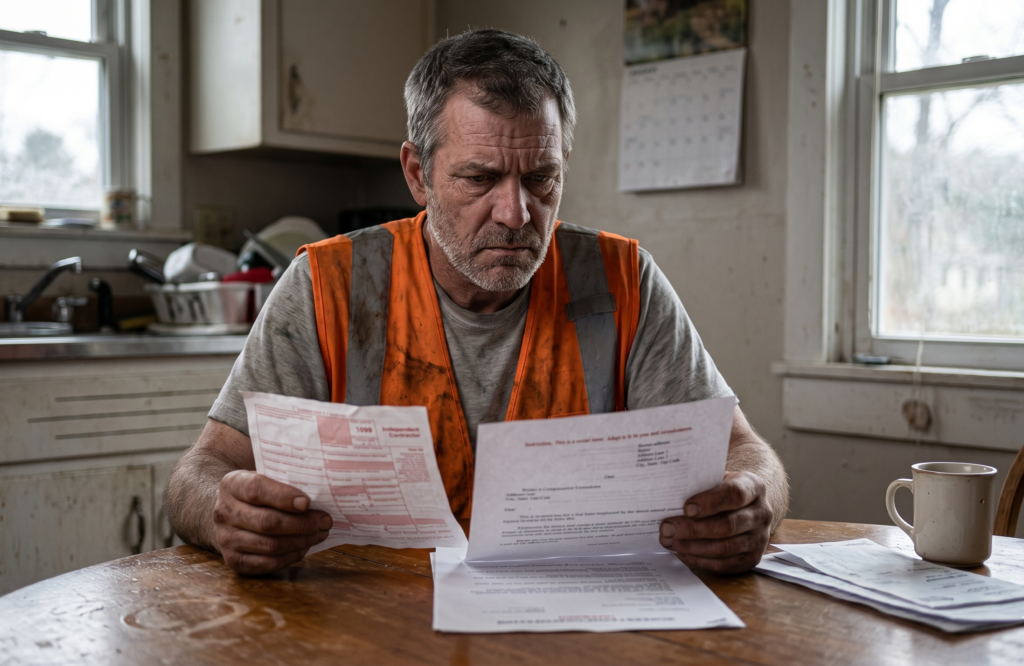
You got hurt on the jobsite, you reach out about workers’ compensation, and then comes a sentence that stops you cold: “You’re a 1099 contractor, so you’re not covered.” In that moment it can feel like the door has been slammed shut before you ever got to ask a question. That single label, often decided long before your injury, can mean the difference between full medical coverage and being told you are on your own.
Here is what frequently goes unexplained on the jobsite: the label on your paperwork is not always the final word. In many states, whether you are truly an “independent contractor” or actually an employee is decided by what the work looks like in reality, not by what a form says. This gap is the heart of what is known as the misclassification trap.
Why the “1099 Contractor” Label Is Not the Final Answer
The most misunderstood point is this: calling someone a contractor does not make them one. Generally, in many states, courts and workers’ compensation boards look past the paperwork and examine how the job was actually performed. A signed agreement that says “independent contractor” can carry far less weight than the day-to-day reality of the work.
Standard guidelines suggest the analysis usually turns on one central idea: control. The more control a company has over how, when, and where you do your work, the more likely you are to be treated as an employee, regardless of the title on your check.
The label is a starting point, not a verdict. Many injured workers walk away from a valid claim the moment they hear “you’re a contractor,” never realizing that the classification itself can be challenged based on the facts of the job.
The Tests Used to Decide Who Is Really an Employee
Different states apply different legal tests, but they tend to circle the same set of questions. Attorneys often note that no single factor decides the issue; instead, the whole picture is weighed together. Standard guidelines suggest these are the factors that commonly matter most:
- Control over the work. Does the company set your hours, direct your tasks, and supervise how the job is done, or do you control the method yourself?
- Tools and equipment. Does the company provide the materials, machinery, and safety gear, or do you bring your own?
- Method of payment. Are you paid a regular wage by the hour or week, or per project as a separate business?
- Permanence of the relationship. Do you work for one company continuously, or move between many clients?
- Whether the work is part of the core business. A framer working full time for a framing company looks very different from a one-time specialty consultant.
Many states use a version of the “ABC test” or a multi-factor “right to control” test. In an ABC-style analysis, a worker is often presumed to be an employee unless the company can prove all three of these points:
- (A) The worker is free from the company’s control and direction in performing the work.
- (B) The work is outside the usual course of the company’s business.
- (C) The worker is genuinely engaged in an independent trade or business of the same nature.
Watch this trap: On a construction site, point (B) is often the company’s weakest link. If a roofing business classifies its roofers as contractors, the work is squarely inside the usual course of that business, which is exactly the kind of detail that can unravel a misclassification.
How State Laws Differ on Misclassification
There is no single national rule here, and the differences between states are dramatic. The exact same working arrangement can be treated as employment in one state and as legitimate contracting in another.
| Approach | What It Generally Means for You |
|---|---|
| Strict ABC test | You are presumed an employee; the company must prove all three ABC factors to classify you otherwise. |
| Right-to-control test | The board weighs many factors, with emphasis on how much the company directs the work. |
| Construction-specific statutes | Some states have special rules that presume construction workers are employees unless narrow conditions are met. |
| Statutory employer rules | A general contractor may be responsible for an uninsured subcontractor’s injured workers. |
State laws vary significantly regarding classification standards and filing deadlines. Several states have passed tough construction-industry rules precisely because misclassification is so common in the trades. Assuming your state follows the same test as a neighboring one is a frequent and costly mistake.

The “Statutory Employer” Safety Net Many Workers Miss
Here is a protection that often goes unmentioned. In many states, if a subcontractor fails to carry workers’ compensation insurance, the general contractor above them can become the “statutory employer” responsible for the injured worker’s benefits. This rule exists to stop companies from dodging coverage by stacking layers of subcontractors.
In practice, this means that even when your direct boss claims you are an uninsured contractor, the larger company running the site may still bear responsibility. Attorneys often examine the entire chain of contractors on a project, not just the name on your paycheck.
Federal and state agencies treat misclassification as a serious issue, in part because it strips workers of safety and wage protections. You can review official guidance on worker classification and the difference between employees and contractors directly from the U.S. Department of Labor (DOL).
Options Injured Workers Commonly Consider
While nothing here is legal or medical advice, the following reflects how this situation is generally navigated. Standard guidelines suggest that documentation and a clear understanding of your state’s classification test are the strongest forms of protection:
- Looking past the label first. Because classification depends on the reality of the work, the actual day-to-day facts generally matter more than the title on the form.
- Preserving evidence of control. Text messages setting your schedule, instructions on how to do the job, and proof that the company supplied tools tend to matter most while they are still available.
- Identifying every company on the site. Knowing the general contractor and other parties can reveal a statutory employer who may carry coverage.
- Not assuming “1099” means “no benefits.” Attorneys often note that a contractor label is frequently the beginning of a dispute, not the end of one.
For a step-by-step walkthrough of how a construction claim moves from injury to resolution, our complete workers’ compensation guide explains each stage in plain language.
Remember: Being handed a 1099 raises a question; it does not always answer one. Whether you are truly a contractor or a misclassified employee depends on control, your state’s specific test, and the real structure of the job site. State laws vary significantly, and the details of your situation always matter.
Find Out If You May Have Been Misclassified
Being told you are “just a contractor” right after a serious injury can make the whole case feel hopeless, as if the paperwork already decided everything. Before you assume your options are gone, it helps to understand the potential value and direction of your claim. Try the free, anonymous Benefits Estimator at HardHat Rights to get a clearer picture in minutes, with no names and no pressure. Start your free Benefits Estimator here and take the guesswork out of what comes next.
Disclaimer: This website is for informational purposes only and does not constitute legal or medical advice. The content provided is not intended to be a substitute for professional medical advice, diagnosis, or treatment. Benefit estimates are approximations based on standard state formulas and do not account for your state’s specific caps or your individual circumstances. Always consult a licensed workers’ compensation attorney in your state for legal advice, and a qualified health provider regarding any medical conditions or treatment.