Failed a Drug Test After a Construction Accident? Your Options Explained
You got hurt on the jobsite, and then came the second blow: a failed post-accident drug test. In that moment, it can feel like the claim is already over, like the company has all the proof it needs to walk away. That fear is exactly what many injured workers are left sitting with, and it is rarely the full picture.
Here is what often goes unexplained on the jobsite: in many states, a positive drug test does not automatically destroy a workers’ compensation claim. The rules around intoxication, causation, and testing procedure are far more complicated than a simple pass-or-fail, and those details can decide whether benefits are denied or paid.
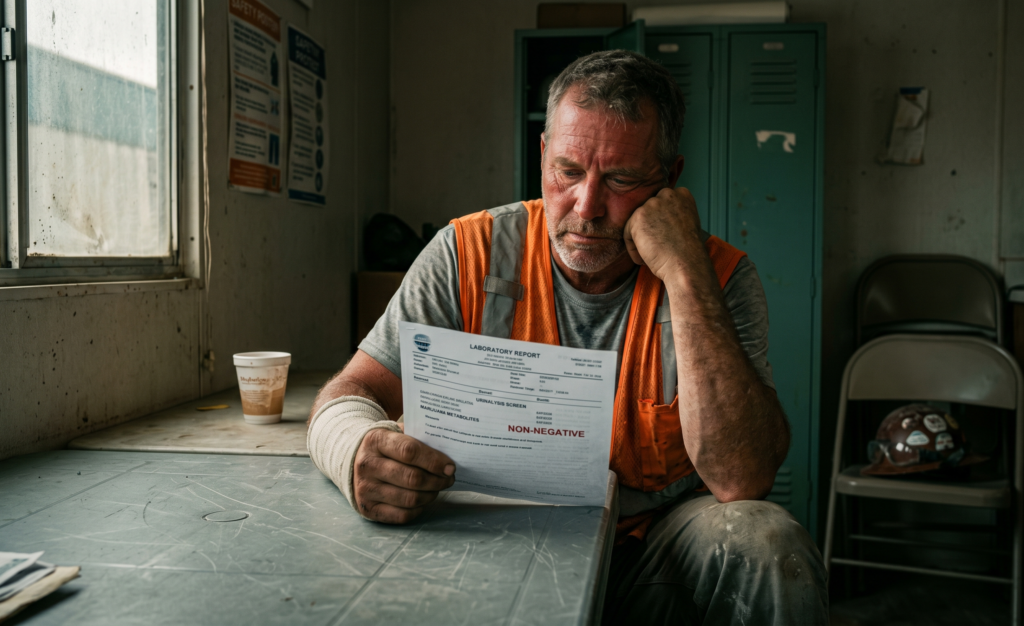
Why a Failed Drug Test Does Not Automatically End Your Claim
The single most misunderstood point is this: a positive test proves presence, not cause. Detecting a substance in your system is not the same as proving that the substance is what caused your accident. In many workers’ compensation systems, the distinction between those two things is everything.
Generally, in many states, the insurer cannot deny a claim simply because a test came back positive. Instead, the law often requires the carrier to connect the substance to the injury itself. Standard guidelines suggest the analysis usually turns on one central question:
Did intoxication actually cause the accident, or did it just happen to be detectable? A worker who tests positive for a substance from days earlier, but was struck by a falling load through no fault of their own, is in a very different position from someone whose impairment directly led to the incident.
This is why the substance matters so much. Marijuana, for example, can remain detectable for weeks after use, long after any impairing effect has worn off. A positive THC result on Monday may say nothing at all about a worker’s condition during a Friday accident, and attorneys often raise exactly that point.
The “Rebuttable Presumption” Trap
This is where many workers get caught off guard. A number of states apply what is called a rebuttable presumption of intoxication. In plain terms, once you test positive above a certain threshold, the law may presume that drugs or alcohol caused your accident, and the burden shifts to you to prove otherwise.
That single procedural rule can flip the entire case. Instead of the insurer having to prove intoxication caused the injury, you may be the one who has to show it did not.
Watch how the insurer uses timing. Carriers sometimes treat any positive result as an automatic win, hoping the worker will simply give up and never challenge it. Whether that presumption can be rebutted, and how, depends heavily on your state’s specific statute.
Standard guidelines suggest that a presumption is rarely the end of the road. Workers and their advocates often rebut it by pointing to factors such as:
- Equipment failure or a defective tool that caused the incident regardless of any substance.
- Unsafe site conditions, such as a missing guardrail, poor lighting, or an unmarked hazard.
- The action of a coworker or third party that triggered the accident.
- Lack of any real impairment, supported by witness accounts of normal behavior, speech, and coordination before the injury.
How State Laws Differ on Post-Accident Drug Tests
There is no single national rule here, and the differences between states are dramatic. The exact same failed test can produce completely different outcomes depending on where you were hurt.
| Approach | What It Generally Means for You |
|---|---|
| Causation required | The insurer must prove intoxication actually caused the accident, not just that a substance was present. |
| Rebuttable presumption | A positive test presumes the drug caused the injury; the worker carries the burden to disprove it. |
| Partial benefit reduction | Benefits may be reduced by a set percentage rather than denied outright. |
| Strict bar | Some states allow a full denial when intoxication is established as a contributing cause. |
State laws vary significantly regarding drug-test deadlines, thresholds, and procedures. The window for testing, the cutoff levels that count as “positive,” and whether marijuana is treated like alcohol all change from state to state. Assuming your state follows the same rule as a neighbor is one of the most common and costly mistakes.

When the Test Itself Can Be Challenged
Many workers assume the test result is final and beyond question. In reality, the testing process is full of points where things can go wrong, and a flawed test may carry far less weight than the insurer suggests. Attorneys often examine the procedure as closely as the result.
Standard guidelines suggest these are common areas of scrutiny:
- Chain of custody. Every step of how the sample was collected, labeled, stored, and transported must typically be documented. Gaps can undermine reliability.
- Timing of the test. A sample taken long after the accident may not reflect your condition at the moment of injury.
- False positives. Certain prescription medications, over-the-counter drugs, and even some foods can trigger a positive result on initial screening.
- Lack of confirmatory testing. A preliminary screen that is never confirmed by a more precise laboratory method is generally considered weaker evidence.
- Lawful prescriptions. A substance taken exactly as prescribed by a physician is treated very differently from illicit use in many systems.
Federal workplace-safety rules also shape how and when post-incident testing is appropriate. You can review official guidance on drug testing and worker protections directly from the U.S. Occupational Safety and Health Administration (OSHA).
Options Injured Workers Commonly Consider
While nothing here is legal or medical advice, the following reflects how this situation is generally navigated. Standard guidelines suggest that documentation and a clear understanding of your state’s rule are the strongest forms of protection:
- Learning the state standard first. Because everything depends on whether your state requires causation or applies a presumption, understanding that rule is generally considered the starting point.
- Preserving evidence of the real cause. Photos of equipment, site conditions, and witness names tend to matter most while memories are fresh.
- Documenting lawful prescriptions. Keeping records of any legitimately prescribed medication can directly address a positive result.
- Not assuming denial is final. Attorneys often note that an initial denial based on a drug test is frequently the beginning of a dispute, not the end of one.
For a step-by-step walkthrough of how a construction claim moves from injury to resolution, our complete workers’ compensation guide explains each stage in plain language.
Remember: A failed drug test raises a question; it does not always answer one. Whether it actually blocks your benefits depends on causation, your state’s specific law, and how reliable the test really was. State laws vary significantly, and the details of your situation always matter.
See Where Your Claim Really Stands After a Failed Test
Being handed a positive drug test after a serious injury can make you feel like the case is hopeless and that no one will believe your side. Before you assume your options are gone, it helps to understand the potential value and direction of your claim. Try the free, anonymous Benefits Estimator at HardHat Rights to get a clearer picture in minutes, with no names and no pressure. Start your free Benefits Estimator here and take the guesswork out of what comes next.
Disclaimer: This website is for informational purposes only and does not constitute legal or medical advice. The content provided is not intended to be a substitute for professional medical advice, diagnosis, or treatment. Benefit estimates are approximations based on standard state formulas and do not account for your state’s specific caps or your individual circumstances. Always consult a licensed workers’ compensation attorney in your state for legal advice, and a qualified health provider regarding any medical conditions or treatment.