Category: Your Benefits & Pay

  • Traumatic Brain Injuries on the Jobsite: When the Hard Hat Isn’t Enough


    Traumatic Brain Injuries on the Jobsite: When the Hard Hat Isn’t Enough

    A hard hat is built to stop a falling bolt or a glancing blow. It was never designed to stop your brain from slamming against the inside of your own skull. That is the hard truth behind a traumatic brain injury, or TBI: the impact that matters most often happens inside the helmet, where no foam liner can reach. A worker can take a fall, get checked at the ER, be told “nothing is broken,” and walk out the door with a brain injury that no one has named yet. Weeks later, the headaches, the lost words, and the sudden flashes of anger arrive, and by then the insurance company may already be calling the case minor.

    Here is what few injured workers are told at the start: a TBI is often an invisible injury, and in workers’ compensation, invisible injuries are the ones insurers fight hardest to minimize. Understanding why is the first step toward protecting a claim that can otherwise slip away.

    Why a “Mild” TBI Is Anything But Minor

    The word doctors often use is concussion, and on paper a concussion is classified as a “mild” traumatic brain injury. That single word does enormous damage to construction claims, because insurers lean on it to suggest the worker simply needs rest and will be fine in a week. The reality on a jobsite is very different.

    Construction brain injuries rarely come from a clean, gentle bump. They come from falls from height, struck-by incidents with swinging loads or falling tools, scaffold collapses, and vehicle strikes. According to federal safety data, falls and struck-by events are among the leading causes of serious harm in the trades, and both deliver the exact kind of force that injures the brain.

    • Falls from scaffolds, ladders, and roofs. The head can strike a surface or whip violently even without a direct hit.
    • Struck-by falling objects. A dropped tool from several stories up carries enough force to injure the brain through the helmet.
    • Equipment and vehicle incidents. Forklifts, loaders, and falling materials can cause sudden acceleration injuries.
    • Explosions and blasts. Pressure waves alone can cause brain trauma with no visible wound at all.

    Insurer tactic to watch for: A common move is to treat any head injury labeled “concussion” or “mild TBI” as a short-term problem that should resolve in days. By anchoring the case to that word early, an insurer can later argue that lingering symptoms must be unrelated, even when the worker has never recovered.

    The Symptoms Insurers Hope You Won’t Connect

    One of the cruelest features of a brain injury is that the worker is often the last to realize how much has changed. Symptoms can appear hours or even days after the accident, and they are easy to blame on stress, poor sleep, or simply getting older. When those symptoms are never documented and linked to the accident, the claim quietly weakens.

    Symptom CategoryWhat It Can Look LikeWhy It Gets Missed
    CognitiveMemory gaps, trouble focusing, losing words mid-sentenceBlamed on age, stress, or being “distracted”
    PhysicalPersistent headaches, dizziness, light and noise sensitivityTreated as ordinary tension or migraines
    EmotionalSudden anger, anxiety, depression, personality shiftsMistaken for a “bad attitude” or unrelated mental health
    SleepInsomnia or sleeping far more than usualDismissed as a lifestyle problem

    The danger is that these changes are reported to a spouse or a foreman, but never to a doctor in writing. In a workers’ compensation system, a symptom that is not in the medical record often does not exist. The injury is real; the paper trail is what proves it.

    How Brain Injury Claims Get Quietly Undervalued

    Because a TBI cannot always be seen on a standard scan, these claims attract specific challenges. Recognizing the patterns helps a worker keep them in perspective rather than being caught off guard:

    1. The “clean scan” argument. A routine CT or X-ray often looks normal after a concussion, and insurers may use that normal image to suggest no real injury occurred, even though many brain injuries do not appear on basic imaging.
    2. The delayed-symptom gap. When symptoms surface days later, insurers may argue the gap proves the brain injury came from something other than the accident.
    3. The “pre-existing” angle. Past headaches, prior concussions, or normal aging may be blamed for current cognitive problems.
    4. The independent exam. A doctor chosen by the insurer may briefly evaluate the worker and conclude the injury has fully resolved.

    Deadlines matter. State laws vary significantly regarding how quickly a head injury must be reported and how long a worker has to file. Some states require notice within days of noticing symptoms, which is especially harsh for a TBI whose effects appear late. Missing a state-specific window can quietly end an otherwise strong claim before it is ever heard.

    Approaches Injured Workers Commonly Consider

    Nothing here is legal or medical advice, but the following reflects how serious brain injury claims are generally navigated. Standard guidelines suggest that the strength of the medical record is what protects the value of a TBI case:

    • Reporting every symptom in writing. Generally, in many states, cognitive and emotional changes carry weight only when a treating provider records them and ties them to the accident.
    • Asking about specialized evaluation. Standard guidelines suggest that neurologists and neuropsychological testing can document injuries that basic scans miss.
    • Keeping a symptom journal. A simple daily record of headaches, memory lapses, and mood changes can help a treating doctor see the full pattern over time.
    • Understanding the long-term stakes. Attorneys often recommend treating a TBI as a potentially permanent condition until a specialist confirms otherwise, rather than accepting an early “all clear.”

    Federal safety standards do not control these state benefit timelines, but they define what a safe jobsite and proper head protection should look like in the first place. You can review official head-protection and fall-safety standards directly at the U.S. Occupational Safety and Health Administration (OSHA).

    For a step-by-step walkthrough of how a construction injury moves from accident to resolution, our complete workers’ compensation guide breaks down each stage in plain language.

    Remember: A traumatic brain injury is often invisible on paper, which is exactly why documentation matters more here than almost anywhere else. State laws vary significantly, and the specifics of each diagnosis always matter.

    See What Your Brain Injury Claim Could Be Worth

    A head injury can change how you think, work, and feel long after the bruises fade, and the pressure to accept that you are “just fine” can be overwhelming when no one can see what is wrong. Before a TBI is written off as a minor concussion, it helps to understand the potential direction and value of the claim. Try the free, anonymous Benefits Estimator at HardHat Rights to get a clearer picture in minutes, with no names and no pressure. Start your free Benefits Estimator here and protect what matters most before anyone decides your injury for you.


  • Spinal Cord Injuries and Herniated Discs: Securing Lifetime Medical Benefits


    Spinal Cord Injuries and Herniated Discs: Securing Lifetime Medical Benefits

    A back injury on a construction site is rarely a single, clean event. It is a herniated disc that flares up months after the fall, the slow loss of feeling in your legs, or the surgeon’s words that change everything: this damage may be permanent. For workers carrying a spinal cord injury, the most important question is not just about today’s treatment. It is whether the system will still cover your care in ten, twenty, or thirty years. That long-term protection is known as lifetime medical benefits, and it is one of the most fiercely contested parts of any serious workers’ compensation claim.

    Here is what few injured workers are told at the start: an insurer’s goal is often to close out future medical responsibility as cheaply and as early as possible. Understanding how that happens is the first step toward protecting decades of care.

    Why Spinal Injuries Are Treated Differently

    Most workplace injuries are expected to heal. A spinal cord injury or a serious herniated disc often does not. Instead, it becomes a lifelong condition that may require ongoing care long after the initial accident. That difference is exactly why these claims draw such intense scrutiny from insurers.

    The reason is simple math. The future cost of a permanent spinal condition can be enormous, and it sits on the insurer’s books as an open-ended liability. Several categories of care can extend for years:

    • Repeat surgeries. Spinal fusions and disc procedures can fail or require revision over time.
    • Pain management. Injections, medication, and specialist visits may continue indefinitely.
    • Physical therapy and mobility aids. Ongoing rehabilitation, braces, or assistive equipment.
    • Hardware replacement. Implanted devices can wear out and need future revision.

    Insurer tactic to watch for: A frequent move is to push for a full and final settlement that “buys out” your future medical care in one lump sum. The offer can look generous on paper, but once you accept and waive future medical rights, the insurer is generally released from paying for that next surgery, even if your spine deteriorates years later.

    Open Medical vs. Closed Medical: The Distinction That Defines Your Future

    When a serious spinal claim resolves, the single most consequential issue is often whether your medical benefits stay open or are closed forever. The two paths lead to very different futures, and the language used in your paperwork controls which one you get.

    FactorOpen (Lifetime) MedicalClosed Medical Settlement
    Future surgeriesGenerally still covered when medically necessaryTypically paid out of your own pocket
    Long-term riskInsurer keeps the financial exposureYou absorb the cost of any decline
    Lump sum offeredOften lower upfront cashLarger one-time check
    If your spine worsensCare channel generally remains availableReopening can be difficult or impossible

    The trade-off is rarely explained plainly. A larger check feels like a win in a moment of financial pressure, but for a permanent spinal condition, that money can run out long before the medical needs do. Attorneys often describe a closed-out spinal settlement as trading away the most valuable part of the claim for short-term relief.

    How Insurers Argue Their Way Out of Lifetime Care

    Because the stakes are so high, spinal claims attract specific challenges. Recognizing these patterns helps you keep them in perspective rather than being caught off guard:

    1. The “pre-existing condition” angle. Many adults have some degree of disc wear, so insurers may argue your herniation existed before the accident. This is one of the most common defenses against spinal claims.
    2. The paper review. A doctor who has never examined you may review your file and label future surgery “not medically necessary.”
    3. The MMI label. Once you reach maximum medical improvement, insurers often push to convert ongoing care into a one-time payout.
    4. The degenerative argument. Future flare-ups may be blamed on natural aging rather than the workplace injury.

    Deadlines matter. State laws vary significantly regarding how long medical benefits can stay open and whether a closed claim can ever be reopened. In some states a spine claim can be reopened within a set number of years if the condition worsens; in others, a signed settlement is final and permanent. Missing a state-specific window can quietly end your right to future care.

    Approaches Injured Workers Commonly Consider

    Nothing here is legal or medical advice, but the following reflects how serious spinal claims are generally navigated. Standard guidelines suggest that the strength of your medical record is what protects long-term care:

    • A clear causation link. Generally, in many states, a detailed note from a treating surgeon connecting the herniation or spinal damage directly to the workplace accident is considered the foundation of the claim.
    • Documenting the permanence. Imaging, surgical reports, and specialist opinions that describe the condition as lasting help counter the “you’ve healed” argument.
    • Understanding what a settlement waives. Attorneys often recommend reading exactly which future rights a lump sum gives up before anything is signed.
    • Knowing your state’s rules. Because reopening rights and time limits differ so dramatically, the specific law of your state is generally treated as decisive.

    Federal safety standards do not control these state benefit timelines, but they define what a safe jobsite and a properly documented injury should look like in the first place. You can review official fall-protection and worker-safety standards directly at the U.S. Occupational Safety and Health Administration (OSHA).

    For a step-by-step walkthrough of how a construction injury moves from accident to resolution, our complete workers’ compensation guide breaks down each stage in plain language.

    Remember: Lifetime medical benefits are usually the most valuable and most targeted part of a spinal claim. Once future care is signed away, it can be nearly impossible to recover. State laws vary significantly, and the specifics of your diagnosis always matter.

    See What Your Spinal Claim Could Be Worth

    A permanent back or spinal cord injury reshapes your future, and the pressure to accept a quick settlement can be overwhelming when bills are piling up. Before you trade away your right to future medical care, it helps to understand the potential direction and value of your claim. Try the free, anonymous Benefits Estimator at HardHat Rights to get a clearer picture in minutes, with no names and no pressure. Start your free Benefits Estimator here and protect what matters most before you sign anything.

  • Maximum Medical Improvement (MMI): What It Means for Your Payout


    Maximum Medical Improvement (MMI): What It Means for Your Payout

    Few phrases change a workers’ compensation claim as quietly — or as completely — as Maximum Medical Improvement, usually shortened to MMI. It is the moment a doctor decides an injury has healed about as much as it ever will. For an injured construction worker, that single determination can shut off weekly checks, trigger the final settlement calculation, and set the value of a permanent injury for life.

    Many workers first hear the term in a letter or a brief exam, with little explanation of how much rides on it. This article breaks down what MMI actually means, how it generally affects the money in a claim, and the points where the timing of an MMI declaration is most often used against the person who got hurt.

    What Maximum Medical Improvement Really Means

    MMI does not mean a worker is fully recovered or pain-free. It means the medical condition has reached a plateau — the point where, in the treating physician’s judgment, further treatment is unlikely to produce significant improvement. A back may still ache, a shoulder may still be weak, but the doctor believes it has stabilized.

    Generally, in many states, reaching MMI is treated as a turning point rather than an ending. Before MMI, the focus is on healing and temporary benefits. After MMI, the focus shifts to measuring what is permanent and deciding what that permanent loss is worth.

    Key distinction: “Maximum Medical Improvement” describes the condition, not the person’s ability to return to the same trade. A worker can be at MMI and still be permanently unable to swing a hammer, climb scaffolding, or lift the way the job demands.

    Why MMI Controls the Size of Your Payout

    MMI matters because so many of the numbers in a claim are calculated from it. Until a worker is declared at MMI, the full extent of the permanent injury is considered unknown. Once MMI is reached, the machinery of valuation starts:

    1. The worker is declared at Maximum Medical Improvement.
    2. A physician assigns an impairment rating — the percentage that measures lasting damage.
    3. That percentage feeds the calculation for permanent disability benefits.
    4. The insurer often uses these figures as the basis for a settlement offer.

    For a closer look at how the impairment percentage itself is built and disputed, our complete guide to construction injury benefits walks through each stage in plain language.

    How MMI Changes Your Weekly Checks

    One of the most immediate effects of MMI is on the wage-replacement checks a worker may be receiving while off the job. Standard guidelines suggest that the type of benefit frequently shifts at this milestone, which is why an MMI letter can feel like the ground moving under a claim.

    StageTypical benefitWhat usually happens
    Before MMITemporary disability (while healing)Weekly checks based on the inability to work during recovery.
    At MMIImpairment rating assignedTemporary benefits often end; permanent benefits are evaluated.
    After MMIPermanent disability or settlementPayment is based on the rated permanent loss, not ongoing recovery.

    State laws vary significantly in how this transition is handled. In some systems, temporary checks stop almost immediately once MMI is declared; in others, a worker may continue to receive certain benefits while the permanent value is sorted out. The label on the benefit can matter as much as the dollar figure.

    The MMI Timing Trick Insurers Watch For

    Because MMI flips the switch from open-ended temporary benefits to a fixed, ratable number, the timing of an MMI declaration carries real financial weight — and it is a pressure point that does not always favor the worker.

    Insurer tactic to watch for: A carrier may rely on a brief, one-time exam by a physician it selects to declare a worker at MMI earlier than the treating doctor would. An early MMI can cut off weekly checks and lock in a lower impairment rating before the body has truly stabilized. Attorneys often recommend comparing the insurer’s opinion against the treating physician’s before treating “MMI” as final.

    Other timing-related pressures that commonly appear around MMI include:

    • An MMI declaration arriving while symptoms are still changing, locking in a rating that may understate the injury.
    • Pending treatment — such as a recommended surgery or therapy — being brushed aside so the claim can be closed sooner.
    • A settlement offer presented as a limited-time opportunity immediately after MMI, before the worker understands the permanent value.
    • Secondary injuries, like a shoulder strained while compensating for a bad knee, never being evaluated at all before the MMI date is set.

    What Workers Often Do When MMI Feels Premature

    There is no single correct response, and the right path depends heavily on the state. That said, attorneys often recommend a measured approach rather than accepting an MMI declaration at face value:

    • Requesting a copy of the full medical report that supports the MMI finding and the reasoning behind it.
    • Asking the treating physician — the doctor who has followed the injury over time — whether they agree the condition has truly stabilized.
    • Confirming that all recommended treatment has been considered before the claim is treated as closed.
    • Checking whether the state allows a second opinion or independent evaluation when the MMI date or rating is disputed.

    Public agencies publish a great deal of free, neutral background that helps workers understand their footing. The federal OSHA Workers’ Rights resource is one authoritative starting point for the protections that apply on a jobsite, and most state workers’ compensation boards publish their own rules on MMI, ratings, and how to challenge them.

    The State-by-State Reality

    It cannot be stressed enough: there is no national MMI standard. State laws vary significantly regarding when MMI can be declared, which doctor’s opinion controls, how quickly temporary benefits end afterward, and the deadlines to dispute the finding. In some states that window to object is measured in weeks, not months, and letting it pass can cement an early MMI — and the lower payout that follows it — permanently.

    Nothing here is legal or medical advice; it is general, informational background meant to help an injured worker ask sharper questions before a single date on a medical form decides the value of the entire claim.

    See What Your Injury May Be Worth at MMI

    Before accepting an MMI declaration or any settlement built on it, it helps to have an independent sense of where the numbers should realistically land. HardHat Rights offers a free, anonymous Benefits Estimator that walks through the same impairment and wage drivers insurers use, without asking for your name or signing you up for anything.

    Try the free, anonymous Benefits Estimator at HardHat Rights to see how your permanent injury compares to what a serious construction claim is typically worth — and decide on MMI informed instead of rushed.

  • What Happens to Your Workers’ Comp if the Construction Company Goes Bankrupt?


    What Happens to Your Workers’ Comp if the Construction Company Goes Bankrupt?

    You were hurt on the jobsite, your claim was moving along, and then the news hits: the construction company you worked for is shutting down or filing for bankruptcy. Suddenly the checks that were covering your bills feel like they are hanging by a thread. For an injured worker, this is a uniquely terrifying moment, because it feels like the one entity responsible for your recovery is about to vanish. The fear is understandable, but the reality is often very different from what it looks like on the surface.

    Here is the single most important thing few workers are told up front: in most cases, your workers’ compensation benefits are not paid by your employer’s bank account. They are paid by an insurance policy. That distinction changes almost everything about what a bankruptcy actually means for your claim.

    Your Employer and Their Insurer Are Two Different Things

    The reason this matters so much comes down to who is legally on the hook. When a company goes under, people assume the obligation to pay benefits disappears with it. But workers’ compensation is built on a layer of protection that usually sits outside the company itself.

    • The employer is the business that hired you. It can close, liquidate, or file for bankruptcy.
    • The insurance carrier is a separate company that issued the workers’ comp policy and actually pays the benefits.
    • The state safety net is a backstop that may exist for situations where coverage fails entirely.

    Key distinction: A bankrupt employer does not automatically mean a bankrupt claim. As long as a valid workers’ compensation policy was in force on the date of your injury, that insurer generally remains responsible for your benefits, regardless of what happens to the company that hired you.

    The Three Scenarios That Decide What Happens Next

    What a bankruptcy means for your benefits depends almost entirely on how the company was covered when you got hurt. Generally, in many states, the situation falls into one of three categories.

    ScenarioWhat Typically Happens to Your BenefitsWhat to Watch For
    Employer had a standard insurance policyThe insurance carrier generally keeps paying your benefits even after the business closes.Your point of contact may change, but the claim usually continues.
    Employer was self-insuredA self-insured company pays claims from its own funds, so a bankruptcy can directly threaten payments.Many states require a security deposit or bond to protect these workers.
    Employer was uninsured (illegally)A state-run uninsured employer fund may step in where no coverage existed at all.These funds often have strict filing rules and limited benefits.

    The most common situation by far is the first one. Most construction companies are legally required to carry workers’ compensation insurance, and that policy is a contract between the insurer and the state, not something that dissolves when the business closes its doors.

    Insurer tactic to watch for: Some workers are quietly told, or simply allowed to assume, that their benefits ended because “the company is gone.” Attorneys often describe this as one of the easiest ways an injured worker gets pushed off a valid claim, simply by giving up on payments that were never actually canceled.

    Where the State Safety Net Comes In

    The scenarios that frighten workers most are the self-insured and uninsured ones, where there may be no healthy insurance carrier standing behind the claim. This is exactly where many states have built backup systems. Standard guidelines suggest these protections commonly include:

    1. Guaranty associations. If an insurance company itself becomes insolvent, a state guaranty fund may take over paying outstanding claims up to certain limits.
    2. Security deposits for self-insurers. States that allow large companies to self-insure often require them to post a bond or deposit that can cover injured workers if the company fails.
    3. Uninsured employer funds. When a company illegally carried no coverage at all, a special state fund may provide benefits to the injured worker.

    These systems exist precisely because lawmakers understood that a worker’s recovery should not depend on whether a private business stays in operation. The protections are real, but they are also highly specific to each state, and they often come with their own deadlines and paperwork.

    Deadlines matter. State laws vary significantly regarding how a claim is transferred when an employer or insurer fails, which fund applies, and how quickly you must file against it. In some states these windows are measured in days or weeks. A bankruptcy notice from the company is not a reason to pause your claim, and treating it as a stopping point can cause far more harm than the bankruptcy itself.

    Why Filing Keeps Going Even During Bankruptcy

    A company’s bankruptcy case and your workers’ compensation claim usually run on two separate tracks. Workers’ comp benefits are generally treated differently from ordinary business debts, which is why an injured worker is rarely just another creditor waiting in line. Because of this separation, a claim often continues moving even while the business is being dismantled in court.

    The practical risk is not usually that benefits legally end. It is that communication breaks down. When a company closes, the people who answered your questions disappear, paperwork gets lost, and no one proactively tells you who to contact. That silence can feel like a denial even when your benefits are technically still owed.

    Approaches Injured Workers Commonly Consider

    Nothing here is legal advice, but the following reflects how a bankruptcy situation is generally navigated. The common thread is keeping your claim attached to the insurer or fund that owes it, rather than to the company that is disappearing.

    • Locate the insurance carrier’s name and policy. Generally, in many states, your claim documents, pay stubs, or the state workers’ comp board can identify who actually insured your employer.
    • Keep every benefit check stub and letter. A written record of what was being paid before the bankruptcy helps show the claim was active and valid.
    • Do not treat a closure as a denial. Standard guidelines suggest that only a formal written denial starts an appeal clock, not a company simply going out of business.
    • Identify the right state fund early. Attorneys often recommend confirming whether a guaranty association or uninsured employer fund applies before assuming there is no money behind the claim.

    While these benefit rules are set by each state rather than by federal law, official resources help establish how a work injury should be reported and protected from the start. You can review worker protections directly at the U.S. Occupational Safety and Health Administration (OSHA).

    For a step-by-step walkthrough of how a construction claim moves from the day of injury all the way to resolution, our complete workers’ compensation guide explains each stage in plain language.

    Remember: A bankrupt employer is not the same as a canceled claim. In most cases the benefits are owed by an insurance policy or a state fund that survives the company itself. State laws vary significantly, and the details of your specific situation always matter.

    Find Out Where Your Claim Really Stands

    Watching the company that hired you fall apart while you are still injured is one of the most stressful moments in the entire process, and the uncertainty alone can push workers into giving up on benefits they are still owed. Before you assume a bankruptcy ended your claim, it helps to understand the potential value and direction of your case. Try the free, anonymous Benefits Estimator at HardHat Rights to get a clearer picture of your situation in minutes, with no names and no pressure. Start your free Benefits Estimator here and take the guesswork out of what comes next.

  • Who Pays the Medical Bills While You Wait for Claim Approval?


    Who Pays the Medical Bills While You Wait for Claim Approval?

    You got hurt on the jobsite, you reported it, and now you are stuck in the worst kind of limbo: the surgery, the physical therapy, or the specialist visit you need is sitting in a “pending” status while the bills keep arriving. For an injured construction worker, this gap is one of the most frightening parts of the entire process. The treatment cannot wait, but the approval has not come through, and no one will give you a straight answer about who is actually responsible for the cost right now.

    Here is the part that few workers are told up front: in most workers’ compensation systems, an unapproved claim does not mean the bills automatically become your personal debt. Where those costs land while you wait depends heavily on the status of your claim and the rules of your state.

    The Three Stages That Decide Who Pays

    To understand who is on the hook for a bill, it helps to know which of three stages your claim is in. Each stage changes the answer dramatically.

    • Reported but not yet accepted. The claim exists in the system, but the insurer has not formally approved or denied it. This is the true “waiting” zone, and it is where most confusion lives.
    • Formally accepted. Once a claim is accepted, the insurer is generally responsible for authorized, related medical treatment, often with no copay or deductible to the worker.
    • Formally denied. A written denial shifts the picture entirely and usually starts strict appeal deadlines. This is a different situation from simply waiting.

    Key distinction: “Pending” is not the same as “denied.” A pending claim has not rejected your treatment, it simply has not approved it yet. Treating a delay as if it were a final no is one of the most common and costly mistakes injured workers make.

    So Who Actually Pays During the Wait?

    While a claim is pending, the bill does not vanish, but it also should not quietly default to you. Generally, in many states, one of a few things happens to that cost while the decision is in process:

    Who May Cover ItHow It Typically WorksWhat to Watch For
    Workers’ comp insurerSome states require the insurer to pay for treatment during an investigation window, even before final acceptance.This often applies only to authorized or emergency care.
    The medical provider (on hold)Many clinics will hold the bill, marking it pending against the comp claim rather than billing you.Providers sometimes bill the patient by mistake when the claim stalls.
    Your private health insuranceIn some situations a group health plan pays first and later seeks reimbursement once comp is settled.Plans may refuse or demand repayment, so the rules matter.
    You, out of pocketThis is the outcome workers fear most, and it is often avoidable with the right paper trail.Paying a comp-related bill yourself can complicate reimbursement later.

    The single most important factor is making sure every provider knows this is a work injury tied to an open workers’ compensation claim. When a clinic has your claim number and the insurer’s information, the bill is far more likely to be routed to the right place instead of to your mailbox.

    Insurer tactic to watch for: A stalled claim can quietly push bills toward you, and a worker who starts paying out of pocket may feel pressured to accept a fast, low settlement just to stop the bleeding. Attorneys often describe this financial squeeze as a strategy, not an accident.

    Why Bills End Up With the Wrong Person

    When a comp-related bill lands on your personal account, it is usually the result of a breakdown in communication rather than a final ruling that you owe the money. Standard guidelines suggest these are the most frequent causes:

    1. The provider was never told it was a work injury. Without a claim number on file, the billing department defaults to your name and insurance.
    2. The claim number was missing or wrong. A single typo can send a bill into the personal-collections track instead of the comp track.
    3. The insurer is investigating. During an open investigation, some bills sit unpaid until a decision is reached.
    4. A collection notice arrived automatically. Automated billing cycles often generate notices that do not reflect the actual status of your comp claim.

    A collection letter during a pending claim is alarming, but it is frequently a billing-system reflex rather than a verdict on who is responsible. Attorneys often recommend documenting every notice in writing and confirming the claim status before assuming the debt is truly yours.

    Approaches Injured Workers Commonly Consider

    Nothing here is legal or medical advice, but the following reflects how a pending-bill situation is generally navigated. The common thread is documentation and keeping the cost attached to the claim, not to you.

    • Keep every bill and notice. A written record of what arrived and when can later show that bills were mishandled during the wait.
    • Confirm providers have the claim number. Generally, in many states, a bill marked against an open comp claim is handled very differently from a personal balance.
    • Note the difference between pending and denied. Standard guidelines suggest treating a written denial as urgent, while a pending status is often something that can still be moved forward.
    • Understand your state’s rules. Some states require treatment to be covered during the investigation period, while others do not, so the local rules drive everything.

    Deadlines matter. State laws vary significantly regarding whether an insurer must pay for treatment before a claim is accepted, how long an investigation can last, and how quickly a denial must be disputed. In some states these windows are measured in days. Missing one can cause more lasting harm than the wait itself.

    While these benefit timelines are set by each state rather than by federal law, official resources help establish how a work injury should be reported and protected from the start. You can review worker protections directly at the U.S. Occupational Safety and Health Administration (OSHA).

    For a step-by-step walkthrough of how a construction claim moves from the day of injury all the way to resolution, our complete workers’ compensation guide explains each stage in plain language.

    Remember: A pending claim is not a bill you have automatically inherited. Keeping every cost tied to your open claim is one of the strongest forms of protection while you wait. State laws vary significantly, and the details of your specific situation always matter.

    See Where Your Claim Really Stands

    Watching bills pile up while your claim sits in “pending” is exhausting, and the uncertainty alone can push workers into decisions they later regret. Before you assume those costs are yours to carry, it helps to understand the potential value and direction of your claim. Try the free, anonymous Benefits Estimator at HardHat Rights to get a clearer picture of your situation in minutes, with no names and no pressure. Start your free Benefits Estimator here and take the guesswork out of what comes next.

  • Cash Pay and “Under the Table” Work: How It Affects Your Injury Claim


    Cash Pay and “Under the Table” Work: How It Affects Your Injury Claim

    You were getting paid in cash. No pay stubs, no W-2, maybe a handshake instead of a contract. Then you got hurt on the job, and now a quiet panic sets in: “Can I even file a claim if I was paid under the table?” It is one of the most common fears on a construction site, and it is exactly the fear that some employers and insurers are counting on.

    Here is the part that often gets lost in the worry: in many states, how you were paid does not automatically decide whether you are covered. Workers’ compensation generally attaches to the employment relationship and the injury itself, not to the format of your paycheck. Being paid in cash is not, by itself, the same as being uninsurable.

    Why “Cash” Does Not Always Mean “No Claim”

    There is a difference between how you were paid and whether you were an employee. Many state systems look at the reality of the working relationship, not the paperwork. If someone controlled your hours, told you what to do and how to do it, and supplied the tools or materials, a number of states would generally treat that as employment, regardless of whether taxes were withheld.

    Insurer tactic to watch for: An adjuster or employer may state flatly that “cash workers aren’t covered” or that “you were just a contractor.” This is frequently pressure, not law. Generally, in many states, misclassifying a worker to avoid coverage does not erase the worker’s rights, and it can actually create liability for the employer.

    That said, this is an area where outcomes shift sharply from one state line to the next. State laws vary significantly regarding how cash-paid and misclassified workers are treated, so the general patterns below are a starting point, not a guarantee for your specific situation.

    Employee vs. Independent Contractor: The Real Dividing Line

    The label your boss used matters far less than the facts. When a dispute arises, many states weigh a set of practical questions to decide whether you were truly an employee. The table below shows the kind of factors that are often considered.

    Factor ConsideredPoints Toward EmployeePoints Toward Contractor
    Control over the workBoss directs hours and methodsYou set your own schedule
    Tools and materialsEmployer provides themYou supply your own
    Ongoing relationshipSteady, continuing workOne-off, project-based job
    How central the work isCore part of the businessOutside the company’s main trade

    Standard guidelines suggest that no single factor decides everything. Attorneys often note that a worker who was called a “contractor” on paper can still be found to be an employee in practice, which is frequently the threshold question in a cash-pay claim.

    The Real Problem: Proving Your Wages

    The harder challenge with under-the-table work usually is not whether you were an employee, but proving how much you actually earned. Workers’ comp wage benefits are typically calculated from your average weekly wage. When there are no pay stubs, an insurer may try to value your wages as low as possible, because a lower wage number means smaller checks for you.

    Even without formal payroll records, many workers are able to assemble a credible picture of their earnings. The following are the kinds of records that are commonly considered persuasive:

    • Bank deposits. Regular cash deposits in consistent amounts can help establish a pattern of income.
    • Text messages and calls. Messages about hours, pay rates, or job assignments often show the working relationship.
    • Personal logs. A simple record of days worked, hours, and amounts received tends to carry weight when kept contemporaneously.
    • Witnesses. Coworkers or others on the crew can sometimes confirm your role and your pay.
    • Photos and timestamps. Jobsite photos can help document that you were present and working.

    Deadlines matter. State laws vary significantly regarding how quickly an injury must be reported, sometimes within just a few days. Delay caused by fear over cash pay is one of the most common reasons valid claims fall apart. Attorneys often recommend treating the reporting window as the first priority.

    What About Taxes and “Getting in Trouble”?

    A frequent worry is that filing a claim will expose unreported income and create tax problems. This is a real and understandable concern, and it is one of the strongest reasons workers stay silent. It is worth knowing that the workers’ compensation system and the tax system are generally administered by different agencies, and a comp claim is fundamentally about an on-the-job injury, not a tax audit.

    Because the tax side can carry genuine consequences, this is an area where the details of your state and your situation truly matter. Federal workplace-safety protections, however, apply to workers on a jobsite regardless of how they are paid, including the right to a safe environment and to report hazards without retaliation. You can review those federal protections directly at the U.S. Occupational Safety and Health Administration (OSHA).

    How Silence Becomes the Insurer’s Best Friend

    The structural problem is simple. A cash-paid worker who is afraid of taxes, status, or “getting the boss in trouble” is a worker who does not report, does not file, and does not push back on a denial. Silence costs the insurance company nothing. A few patterns tend to repeat:

    1. The off-the-books offer. A small cash sum may be presented as a favor, in exchange for never filing a formal claim.
    2. The contractor label. Suddenly you are called “self-employed,” even though nothing about your daily work changed.
    3. The lowball wage. With no stubs to argue from, your average weekly wage is set as low as the insurer thinks it can get away with.
    4. Counting on no follow-up. The whole approach assumes you will not gather records or challenge the classification.

    Approaches Injured Cash Workers Commonly Consider

    While nothing here is legal advice, the following reflects how this situation is generally navigated. Standard guidelines suggest that documentation is the single most powerful form of protection a cash-paid worker has:

    • Reporting the injury promptly. A clear, early record of how and when the injury happened tends to protect the claim before any wage dispute begins.
    • Gathering wage evidence early. Bank records, messages, and witness names are often easiest to collect right after the injury, not months later.
    • Understanding state-specific rules. Because outcomes differ so sharply, knowing how your state treats cash and misclassified workers is generally considered essential.
    • Consulting confidentially. Attorneys often offer free initial consultations and can explain how the wage and tax questions interact in your particular state.

    For a broader walkthrough of how a construction claim moves from injury to resolution, our complete workers’ compensation guide breaks down each stage in plain language.

    Remember: An injury that happened while you were working is, in many states, an injury the system was built to address. State laws vary significantly, and the specifics of your pay and your situation always matter, but being paid in cash is not, by itself, a legal disqualification.

    See What Your Claim May Be Worth Without Giving Your Name

    If you were paid under the table, the idea of “filing” anything can feel risky. That is exactly why it helps to understand the potential value and direction of your claim before you decide anything. Try the free, anonymous Benefits Estimator at HardHat Rights to get a clearer picture in minutes, with no names, no pay stubs, and no pressure. Start your free Benefits Estimator here and take the guesswork out of what comes next.

  • Undocumented Workers’ Rights: Can You Get Workers’ Comp Without Legal Status?


    Undocumented Workers’ Rights: Can You Get Workers’ Comp Without Legal Status?

    It is one of the most frightening questions an injured construction worker can ask, and it is often asked in a whisper: “If I file a claim, will they come for me?” The fear is real, and insurance companies know it. That fear is sometimes the most powerful tool they have to make a legitimate injury simply disappear.

    Here is the part many workers are never told: in a large number of states, your immigration status does not automatically erase your right to workers’ compensation for an injury that happened on the job. The protection generally attaches to the work itself, not to a document.

    Why Status and the Injury Are Treated Separately

    Workers’ compensation exists to cover medical bills and lost wages when someone is hurt performing their job. Many state systems define an “employee” broadly, and a number of state courts have concluded that the definition can include workers regardless of documentation. The reasoning is practical: if employers could injure undocumented workers without consequence, there would be a powerful incentive to hire them precisely because they are easier to exploit.

    Insurer tactic to watch for: A claims adjuster may hint that filing will “trigger immigration” or that you are “not eligible.” This is frequently pressure, not law. Generally, in many states, the compensation system and the immigration system operate on entirely separate tracks.

    That said, this is an area where the ground shifts dramatically from one state line to the next. State laws vary significantly regarding which benefits an undocumented worker can actually collect, and some categories of benefits are treated differently than others.

    What Benefits May and May Not Be Available

    Even in worker-friendly states, undocumented status can affect which benefits flow, especially those tied to returning to work. The table below shows the general pattern attorneys often describe, but the specifics depend entirely on your state.

    Benefit TypeWhat It CoversGeneral Availability
    Medical treatmentDoctor visits, surgery, therapyOften available in many states
    Temporary disabilityPartial wages while you healFrequently available
    Permanent disabilityLasting impairment paymentsVaries widely by state
    Vocational retrainingJob retraining programsOften limited or denied

    The retraining gap is common because such programs assume the worker can be legally re-employed. Standard guidelines suggest this is one of the most contested areas, and it is frequently where insurers concentrate their fight.


    The “Immigration Threat” and What the Law Often Says

    One of the most damaging tactics is the implied threat: cooperate quietly, or your status becomes a problem. It is worth knowing that, in many jurisdictions, retaliating against a worker for filing a compensation claim is itself prohibited. Some states treat threats tied to immigration status as a serious violation.

    Federal workplace-safety standards also protect all workers on a jobsite, regardless of immigration status, including the right to a safe environment and to report hazards. You can review those federal protections directly at the U.S. Occupational Safety and Health Administration (OSHA).

    Deadlines matter. State laws vary significantly regarding how quickly an injury must be reported, sometimes within days. Fear-driven delay is one of the most common reasons valid claims collapse. Attorneys often recommend treating the reporting window as the first priority, separate from any worry about status.

    How Fear Quietly Becomes the Insurer’s Strategy

    The structural problem is simple. An undocumented worker who is afraid to speak is a worker who does not file, does not appeal, and does not push back on a lowball offer. Silence is inexpensive for the insurance company. Several patterns tend to appear:

    1. Discouraging the first report. A supervisor may suggest handling the injury “off the books” to avoid paperwork.
    2. Quick cash offers. A small sum may be presented as a favor, in exchange for never filing a formal claim.
    3. Status as leverage. Vague references to “checking documents” can appear right after a worker mentions a lawyer.
    4. Counting on no follow-up. The system assumes an undocumented worker will not navigate appeals or hearings alone.

    Approaches Injured Workers Commonly Consider

    While nothing here is legal advice, the following reflects how this situation is generally navigated. Standard guidelines suggest that information and documentation are the strongest forms of protection:

    • Documenting the injury early. A clear record of how and when the injury happened tends to protect the claim no matter what later disputes arise.
    • Understanding state-specific rules. Because outcomes differ so sharply, knowing how your particular state treats undocumented claims is often considered essential.
    • Consulting confidentially. Attorneys often note that an initial consultation about a comp claim does not require sharing status with immigration authorities.
    • Separating two systems. Many advocates remind workers that a compensation claim and an immigration case are generally handled by completely different agencies.

    For a broader walkthrough of how a construction claim moves from injury to resolution, our complete workers’ compensation guide breaks down each stage in plain language.

    Remember: An injury that happened while you were working is, in many states, an injury the system was built to address. State laws vary significantly, and the specifics of your situation always matter, but fear alone is not a legal disqualification.

    See Where You Stand Without Giving Your Name

    If status is part of your worry, the idea of “filing” anything can feel dangerous. That is exactly why it helps to understand the potential value and direction of your claim before you decide anything. Try the free, anonymous Benefits Estimator at HardHat Rights to get a clearer picture in minutes, with no names, no documents, and no pressure. Start your free Benefits Estimator here and take the guesswork out of what comes next.

  • Lump Sum vs. Structured Settlements: Which Is Better for Your Future?


    Lump Sum vs. Structured Settlements: Which Is Better for Your Future?

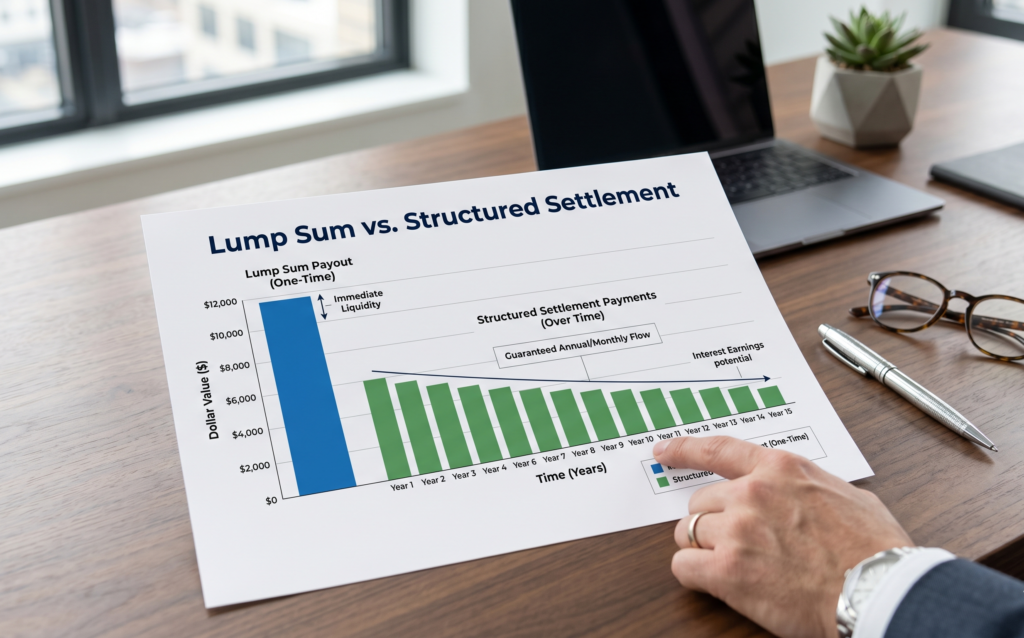
    When a workers’ compensation claim moves toward resolution, an injured construction worker is often handed a choice that will shape their finances for years: take the money as one large lump sum, or accept a structured settlement that pays out over time. Both close the claim. But they protect — and expose — a worker in very different ways, and the carrier rarely explains the trade-offs in plain terms.

    This article breaks down how each option actually works, who tends to benefit from each, and the quiet details that can turn a fair-looking number into a regret.

    What a Lump Sum Settlement Really Means

    A lump sum settlement is a single, one-time payment that closes the claim. In exchange for that check, a worker generally gives up the right to come back for more money later — and, in many agreements, the right to future medical care tied to the injury.

    Generally, in many states, a lump sum is attractive for clear reasons:

    • Immediate access to the full amount, useful for paying down debt that piled up while wages stopped.
    • Control over how and when the money is used or invested.
    • A clean break from the insurance carrier, with no ongoing claim to manage or defend.

    The risk lives in that same freedom. A lump sum has to last as long as the consequences of the injury do — sometimes a lifetime — and once it is spent, there is usually no going back to the carrier for more.

    Insurer trick to watch for: A lump sum is sometimes presented as the “simple” option precisely because it lets the carrier close the file and erase future medical exposure in one move. Attorneys often recommend asking, in writing, whether the lump sum closes future medical benefits — because that single clause can be worth more than the check itself.

    What a Structured Settlement Really Means

    A structured settlement replaces one large payment with a stream of guaranteed payments over a set period — monthly, quarterly, annually, or in scheduled larger installments. It is typically funded through an annuity purchased from an insurance company.

    Standard guidelines suggest structured payments tend to favor workers who need long-term stability:

    • Predictable income that replaces lost wages on a steady schedule.
    • Protection from overspending, since the money cannot all disappear at once.
    • Potential tax advantages, as qualifying workers’ comp settlement payments are often treated favorably — though rules vary and a tax professional should confirm any specific situation.

    The trade-off is flexibility. A structured plan is difficult to change once signed, and it may not provide enough cash up front for a large, immediate need — a home modification, a vehicle, or clearing high-interest debt.

    Lump Sum vs. Structured: A Side-by-Side Look

    FactorLump SumStructured Settlement
    Access to moneyAll at once, immediatelySpread out on a fixed schedule
    Risk of running outHigher — depends on disciplineLower — payments are guaranteed
    Flexibility to change laterFull control after payoutVery limited once signed
    Best suited forLarge immediate needs, debt payoffLong-term living expenses, lasting injuries
    Future medical careOften closed out — read carefullyMay be structured separately

    Which One Fits Which Worker?

    There is no universally “better” option — only the option that fits a specific injury, family situation, and state. Generally, in many states, the decision tends to turn on a few honest questions:

    1. How permanent is the injury? A lasting impairment that limits future earning often pairs better with steady, long-term payments.
    2. What does the next year demand? Urgent debt or a major one-time cost may call for cash up front.
    3. How comfortable is the worker managing a large sum? A structure removes the pressure of stretching a single check across decades.
    4. Is future medical care still likely? Closing that door for a lump sum can be the most expensive part of the deal.

    Deadline warning: State laws vary significantly regarding settlement approval, revocation windows, and how future medical benefits may be closed. In some states a worker has only days to reconsider a signed agreement; in others, a judge must approve the terms first. Because a finalized settlement is generally very difficult to undo, attorneys often recommend confirming every applicable deadline and approval step before agreeing to a structure or a lump sum.

    The Hybrid Option Many Workers Overlook

    The choice is not always all-or-nothing. Standard guidelines suggest that many settlements can be split — a partial lump sum to cover immediate debts and pressing needs, with the remainder structured into guaranteed payments for long-term stability. This hybrid approach can capture the strengths of both while softening the weaknesses of each.

    For a broader walk-through of how settlement decisions fit into the wider claims process, our complete guide to construction injury benefits covers each stage in plain language.

    Where Official Information Fits In

    Settlement pressure often relies on the assumption that a worker doesn’t fully understand their rights or the long-term cost of their injury. Public agencies publish a great deal of free, neutral information. The U.S. Department of Labor’s Workers’ Compensation resource is one authoritative starting point for understanding how these programs are structured.

    Pairing that public information with your own medical records and a clear sense of your future needs creates a far stronger foundation than relying on the carrier’s framing alone.

    How Workers Typically Approach the Decision

    There is no single correct answer, and the right path depends heavily on the injury and the state. That said, attorneys often recommend a measured rather than rushed approach:

    • Requesting the full settlement terms in writing, including any language about future medical care.
    • Mapping out realistic long-term costs before deciding how much cash is truly needed up front.
    • Understanding how the local state system treats settlement taxes and approval before signing.
    • Considering whether a hybrid split serves the family better than either extreme.

    State laws vary significantly, and a strategy that fits a worker in one state may be entirely wrong in another. Nothing here is legal or financial advice; it is general, informational background to help an injured worker ask better questions.

    See What Your Claim May Actually Be Worth First

    Before choosing between a lump sum and a structure, it helps to have an independent sense of the range your claim might fall into. HardHat Rights offers a free, anonymous Benefits Estimator that walks through the same value drivers insurers use — medical costs, lost wages, and impairment — without asking for your name or signing you up for anything.

    Try the free, anonymous Benefits Estimator at HardHat Rights to see how a settlement offer compares to your real long-term needs — and walk into the lump sum versus structured decision informed instead of pressured.

  • Permanent Partial Disability (PPD) Ratings Explained for Construction Workers


    Permanent Partial Disability (PPD) Ratings Explained for Construction Workers

    For many injured construction workers, the most important number in the entire claim is one they never see being decided: the Permanent Partial Disability rating, or PPD. It is the percentage a doctor assigns once an injury has healed as much as it ever will, and it often determines the size of the final check — sometimes the difference between a few thousand dollars and tens of thousands.

    Yet the rating process is quiet, technical, and easy to influence. A low number written into a single medical report can quietly shrink an entire settlement. This article explains what a PPD rating actually measures, how it is normally calculated, and the points where the figure is most often pushed downward.

    What a PPD Rating Actually Measures

    Permanent Partial Disability applies when a work injury leaves lasting impairment but does not prevent a worker from doing any work at all. A back that no longer bends the way it did, a knee that gives out, a hand that lost grip strength after a crush injury — these are the kinds of permanent limitations a PPD rating is meant to capture.

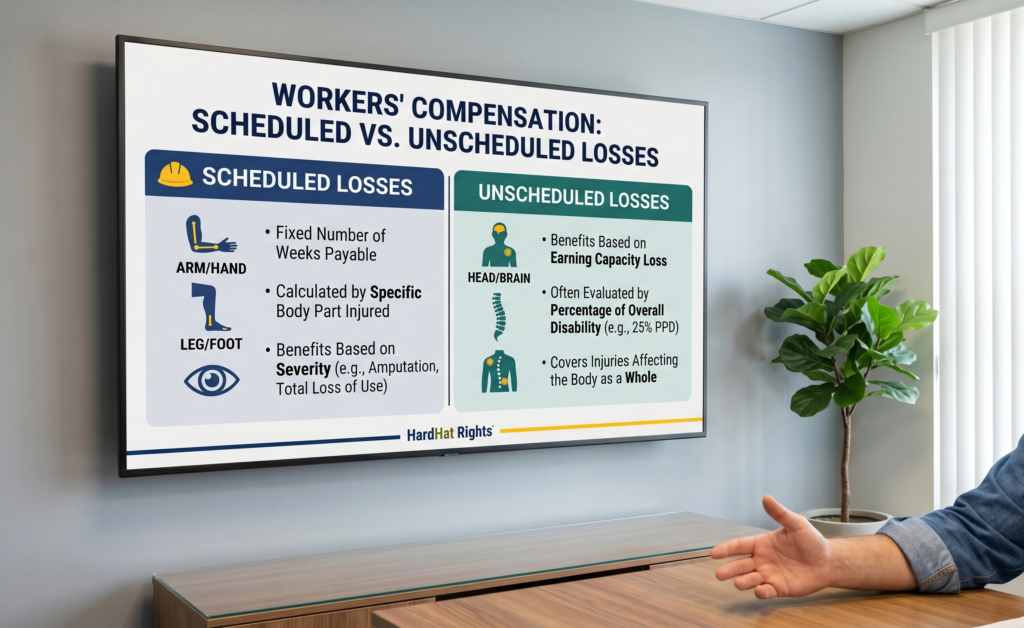
    Generally, in many states, the rating is expressed as a percentage of impairment. That percentage may be tied to a specific body part (a “scheduled” loss, such as an arm or a foot) or to the body as a whole (an “unscheduled” loss, such as a back or neck injury). The higher the percentage, the larger the benefit that flows from it.

    Why this number controls the claim: Most permanent benefits are calculated by multiplying the impairment percentage by a set number of weeks and by the worker’s weekly compensation rate. Shaving even a few percentage points off the rating can erase thousands of dollars from the final payout.

    When the Rating Is Assigned: Maximum Medical Improvement

    A PPD rating is not given while a worker is still healing. It usually comes at a milestone doctors call Maximum Medical Improvement, or MMI — the point at which the condition is considered stable and unlikely to improve much further with treatment.

    Reaching MMI does not mean the worker is “all better.” It means the body has recovered as much as it realistically will. Standard guidelines suggest the impairment is measured at this stage because only then can a doctor estimate what is truly permanent. Being declared at MMI is a significant turning point in a claim, because it often shifts the focus from medical treatment to the value of the permanent loss.

    How the Rating Is Normally Calculated

    The exact method varies, but the general structure most systems follow looks like this:

    1. The worker reaches Maximum Medical Improvement (MMI).
    2. A physician examines the injury and assigns an impairment percentage, frequently using a standardized reference such as the AMA Guides to the Evaluation of Permanent Impairment.
    3. That percentage is applied to a state-defined number of weeks for the affected body part or for the body as a whole.
    4. The result is multiplied by the worker’s weekly compensation rate to produce the benefit amount.

    The dispute is rarely about the arithmetic. It is almost always about step 2 — the percentage itself, and who decides it.

    Scheduled vs. Unscheduled Losses

    Understanding which category an injury falls into helps explain how the final number is built:

    Type of lossWhat it coversHow it is generally valued
    ScheduledSpecific body parts — arm, hand, finger, leg, foot, eye, hearing.A fixed number of weeks is set by statute for each part; the impairment percentage is applied to that number.
    UnscheduledInjuries to the back, neck, spine, or other “whole body” systems.Often based on a whole-person impairment rating and, in some states, on lost earning capacity.

    State laws vary significantly in how they treat these two categories. Some states value unscheduled injuries purely on the medical impairment percentage; others factor in age, education, and the worker’s ability to return to the same trade — which can matter enormously for someone whose body is their living.

    How a Low Rating Quietly Costs You

    Because so much money rides on a single percentage, the rating exam is a place where claims are often won or lost. The doctor who performs it is frequently chosen — and paid — by the insurance company, and not every impairment evaluation is generous.

    Insurer tactic to watch for: A carrier may rely on a brief, one-time impairment exam by a physician it selects, then treat that low number as final. A treating doctor who has followed the injury for months may reach a very different rating. Attorneys often recommend comparing the two rather than accepting the insurer’s figure as the last word.

    Other common ways a rating ends up too low include:

    • The exam is rushed, and the worker downplays pain or limitations out of habit or pride.
    • The doctor rates only the most obvious injury and overlooks secondary ones, such as a shoulder that was hurt compensating for a bad knee.
    • An older edition of the impairment guide is used, or the wrong section is applied.
    • Pain, range-of-motion loss, or nerve symptoms are measured on a single good day rather than across normal conditions.

    For a broader walk-through of how the rating connects to the rest of the claims process, our complete guide to construction injury benefits covers each stage in plain language.

    What Workers Often Do When a Rating Seems Too Low

    There is no single correct path, and the right one depends heavily on the state. That said, attorneys often recommend a careful approach rather than signing off on the first number offered:

    • Requesting a copy of the full impairment report and reading exactly how the percentage was reached.
    • Asking the treating physician — the one who knows the injury best — whether they agree with the rating.
    • Looking into whether the state allows a second opinion or independent rating when the figures conflict.
    • Confirming that every injured body part, not just the main one, was evaluated.

    Public agencies also publish a great deal of free background that helps workers understand their footing. The federal OSHA Workers’ Rights resource is one authoritative starting point for understanding the protections that apply on a jobsite, and many state workers’ compensation boards publish their own impairment schedules and dispute procedures.

    The State-by-State Reality

    It cannot be stressed enough: there is no national PPD system. State laws vary significantly regarding which impairment guide is used, how many weeks each body part is worth, whether earning capacity counts, and — critically — the deadlines to dispute a rating. In some states that window is measured in weeks, not months, and missing it can lock in a low number permanently.

    Nothing here is legal or medical advice; it is general, informational background meant to help an injured worker ask sharper questions before accepting a figure that will shape the entire outcome of the claim.

    See What Your Permanent Injury May Be Worth

    Before accepting any impairment rating or settlement built on it, it helps to have an independent sense of where the numbers should realistically land. HardHat Rights offers a free, anonymous Benefits Estimator that walks through the same impairment and wage drivers insurers use, without asking for your name or signing you up for anything.

    Try the free, anonymous Benefits Estimator at HardHat Rights to see how your rating compares to what a serious construction injury is typically worth — and walk into your next conversation with the carrier informed instead of shortchanged.

  • How Your Average Weekly Wage (AWW) Is Calculated — And How Insurers Shortchange You


    How Your Average Weekly Wage (AWW) Is Calculated — And How Insurers Shortchange You

    Almost every dollar of a workers’ compensation claim — the weekly checks while a construction worker is off the job, and often the final settlement — is built on a single number: the Average Weekly Wage, or AWW. If that number is set too low, every benefit calculated from it is too low as well. Yet the AWW is one of the most commonly understated figures on a claim, and most injured workers never see the math behind it.

    This article breaks down how the AWW is normally calculated, the parts of a construction paycheck that carriers conveniently leave out, and the warning signs that the wage figure on your claim may have been quietly trimmed.

    What the Average Weekly Wage Actually Is

    The AWW is meant to represent what a worker truly earned, on average, before the injury — the baseline a state uses to decide how much wage-replacement to pay. Generally, in many states, the AWW is found by taking gross earnings over a defined look-back period and dividing by the number of weeks in it.

    The most common look-back period is the 52 weeks immediately before the date of injury, though this varies. Some states use 13 or 26 weeks; others use the worker’s employment history if it is shorter than a full year. Once the AWW is set, the weekly check is usually a percentage of it — frequently around two-thirds (66.6%) of the AWW, again subject to wide state-by-state differences and a statutory maximum.

    Why this number matters so much: The AWW is multiplied across the entire life of a claim. A wage figure that is understated by even $150 a week can compound into thousands of dollars in lost benefits over the months — or years — a serious injury keeps a worker off the job.

    The Standard Calculation, Step by Step

    While the exact formula differs by state, the general structure most systems follow looks like this:

    1. Identify the look-back period (commonly the 52 weeks before the injury).
    2. Add up total gross earnings during that period — before taxes, and ideally including more than just base hourly pay.
    3. Divide that total by the number of weeks in the period to reach the AWW.
    4. Apply the state’s benefit percentage (often around two-thirds) to set the weekly compensation rate.

    The arithmetic looks simple. The dispute is almost never about the division — it is about what gets counted as earnings in step 2. That is where money goes missing.

    How Insurers Shortchange the Number

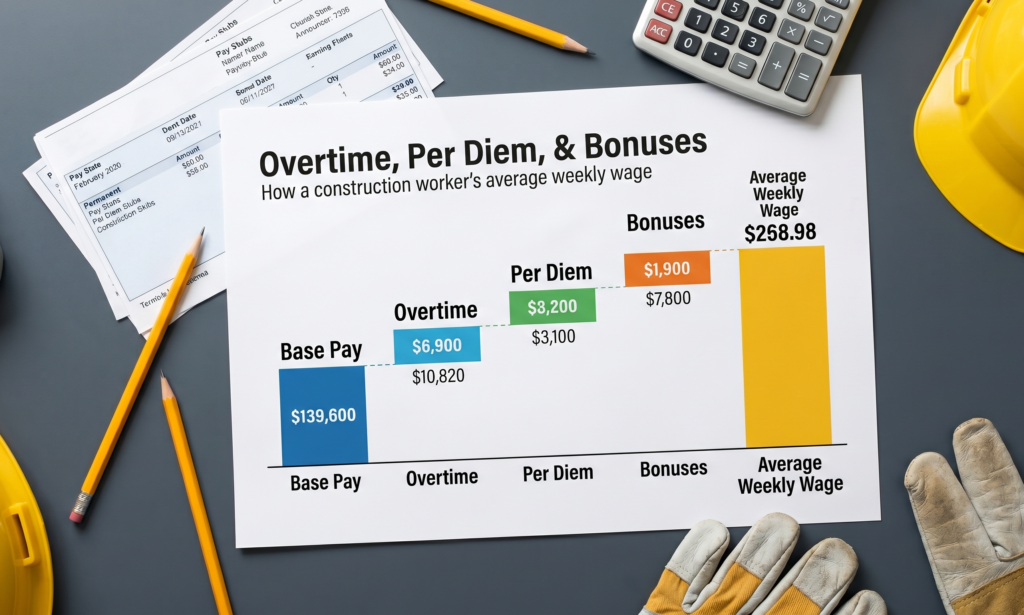
    Construction pay is rarely just a flat hourly rate. It moves with overtime, seasonal hours, second jobs, and project-based extras. Each of those moving parts is an opportunity for a carrier to calculate a lower AWW — and a worker who only checks the base rate may never notice.

    Standard guidelines suggest the AWW should reflect true earning capacity, not a stripped-down version of it. Here are the categories most often left out:

    Often excluded by the carrierWhy it frequently belongs in the AWW
    Overtime payFor trades that routinely work 50–60 hour weeks, overtime is real, recurring income — not a bonus.
    Per diem / travel allowancesIn many states, regular per diem that functions as wages may be includable rather than ignored.
    Bonuses and incentive payRecurring production or safety bonuses can form part of true average earnings.
    Second job / concurrent employmentSeveral states allow wages from a second job to be combined into one AWW.
    The value of fringe benefitsSome systems count the lost value of employer-paid health insurance or lodging.

    Insurer trick to watch for: A common tactic is to base the AWW on a single recent pay stub from a slow week, or to use only base hourly pay while quietly dropping overtime and per diem. Attorneys often recommend requesting a full year of earnings records and comparing the carrier’s figure line by line.

    The “Short Tenure” Trap

    Workers who were recently hired, or who work seasonally, are especially exposed. If a carrier divides a few weeks of low early-season earnings across a full period, the resulting AWW can look far below what the worker would realistically have earned over a normal year.

    Generally, in many states, the law provides alternative methods for these situations — such as using the wages of a comparable worker in the same trade, or annualizing seasonal earnings — precisely so a short or interrupted work history does not unfairly sink the number. Whether those methods apply, and exactly how, depends heavily on the state.

    For a broader walk-through of how the wage figure connects to the rest of the claims process, our complete guide to construction injury benefits covers each stage in plain language.

    Red Flags That Your AWW May Be Too Low

    No single sign proves the number was understated, but several together are worth a closer look:

    • The weekly check feels far smaller than two-thirds of your normal take-home pay for a busy week.
    • The carrier never asked for a full year of pay records.
    • Your overtime or per diem appears nowhere in their figure.
    • You held a second job that was never mentioned.
    • The AWW was based on a slow stretch of work rather than a representative period.

    Where Official Wage and Safety Data Fits In

    Understated wage figures often rely on a worker not knowing what their trade typically earns or what protections exist. Public agencies publish a great deal of free wage and safety information. The federal OSHA Workers’ Rights resource is one authoritative starting point for understanding the obligations employers carry on a jobsite, and many state labor departments publish prevailing wage data for construction trades.

    Pairing that public information with your own pay stubs and tax records creates a far stronger basis for checking the AWW than relying on the carrier’s number alone.

    How Workers Typically Verify the Number

    There is no single correct path, and the right one depends on the state and the trade. That said, attorneys often recommend a methodical approach rather than accepting the figure at face value:

    • Gathering all pay records — ideally a full 52 weeks, including overtime and per diem.
    • Asking the carrier in writing exactly how the AWW was calculated and what period it used.
    • Listing any concurrent employment that may be combinable in that state.
    • Checking whether a seasonal or short-tenure method should have applied instead.

    State laws vary significantly regarding the look-back period, which earnings count, and the deadlines to dispute a wage rate — in some states that window is measured in days, not months. Nothing here is legal or financial advice; it is general, informational background to help an injured worker ask better questions.

    See What Your Benefits May Actually Be Worth

    Before accepting any weekly rate, it helps to have an independent sense of where your AWW — and the benefits built on it — should realistically land. HardHat Rights offers a free, anonymous Benefits Estimator that walks through the same wage and value drivers insurers use, without asking for your name or signing you up for anything.

    Try the free, anonymous Benefits Estimator at HardHat Rights to see how your weekly check compares to what your real earnings suggest — and walk into your next conversation with the carrier informed instead of shortchanged.