Author: HardHat Rights

  • Permanent Partial Disability (PPD) Ratings Explained for Construction Workers


    Permanent Partial Disability (PPD) Ratings Explained for Construction Workers

    For many injured construction workers, the most important number in the entire claim is one they never see being decided: the Permanent Partial Disability rating, or PPD. It is the percentage a doctor assigns once an injury has healed as much as it ever will, and it often determines the size of the final check — sometimes the difference between a few thousand dollars and tens of thousands.

    Yet the rating process is quiet, technical, and easy to influence. A low number written into a single medical report can quietly shrink an entire settlement. This article explains what a PPD rating actually measures, how it is normally calculated, and the points where the figure is most often pushed downward.

    What a PPD Rating Actually Measures

    Permanent Partial Disability applies when a work injury leaves lasting impairment but does not prevent a worker from doing any work at all. A back that no longer bends the way it did, a knee that gives out, a hand that lost grip strength after a crush injury — these are the kinds of permanent limitations a PPD rating is meant to capture.

    Generally, in many states, the rating is expressed as a percentage of impairment. That percentage may be tied to a specific body part (a “scheduled” loss, such as an arm or a foot) or to the body as a whole (an “unscheduled” loss, such as a back or neck injury). The higher the percentage, the larger the benefit that flows from it.

    Why this number controls the claim: Most permanent benefits are calculated by multiplying the impairment percentage by a set number of weeks and by the worker’s weekly compensation rate. Shaving even a few percentage points off the rating can erase thousands of dollars from the final payout.

    When the Rating Is Assigned: Maximum Medical Improvement

    A PPD rating is not given while a worker is still healing. It usually comes at a milestone doctors call Maximum Medical Improvement, or MMI — the point at which the condition is considered stable and unlikely to improve much further with treatment.

    Reaching MMI does not mean the worker is “all better.” It means the body has recovered as much as it realistically will. Standard guidelines suggest the impairment is measured at this stage because only then can a doctor estimate what is truly permanent. Being declared at MMI is a significant turning point in a claim, because it often shifts the focus from medical treatment to the value of the permanent loss.

    How the Rating Is Normally Calculated

    The exact method varies, but the general structure most systems follow looks like this:

    1. The worker reaches Maximum Medical Improvement (MMI).
    2. A physician examines the injury and assigns an impairment percentage, frequently using a standardized reference such as the AMA Guides to the Evaluation of Permanent Impairment.
    3. That percentage is applied to a state-defined number of weeks for the affected body part or for the body as a whole.
    4. The result is multiplied by the worker’s weekly compensation rate to produce the benefit amount.

    The dispute is rarely about the arithmetic. It is almost always about step 2 — the percentage itself, and who decides it.
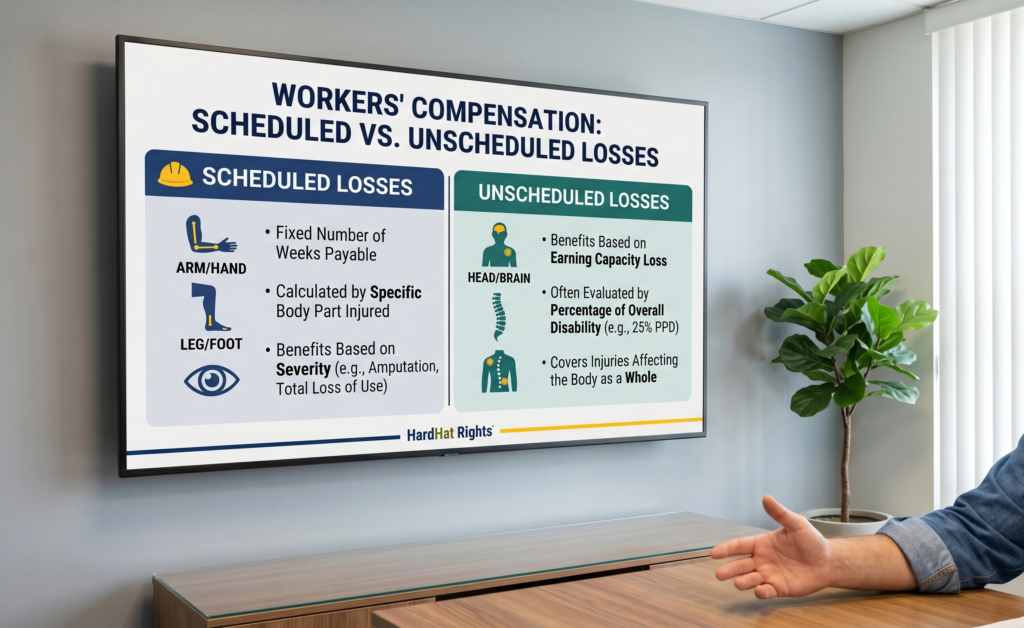
    Scheduled vs. Unscheduled Losses

    Understanding which category an injury falls into helps explain how the final number is built:

    Type of lossWhat it coversHow it is generally valued
    ScheduledSpecific body parts — arm, hand, finger, leg, foot, eye, hearing.A fixed number of weeks is set by statute for each part; the impairment percentage is applied to that number.
    UnscheduledInjuries to the back, neck, spine, or other “whole body” systems.Often based on a whole-person impairment rating and, in some states, on lost earning capacity.

    State laws vary significantly in how they treat these two categories. Some states value unscheduled injuries purely on the medical impairment percentage; others factor in age, education, and the worker’s ability to return to the same trade — which can matter enormously for someone whose body is their living.

    How a Low Rating Quietly Costs You

    Because so much money rides on a single percentage, the rating exam is a place where claims are often won or lost. The doctor who performs it is frequently chosen — and paid — by the insurance company, and not every impairment evaluation is generous.

    Insurer tactic to watch for: A carrier may rely on a brief, one-time impairment exam by a physician it selects, then treat that low number as final. A treating doctor who has followed the injury for months may reach a very different rating. Attorneys often recommend comparing the two rather than accepting the insurer’s figure as the last word.

    Other common ways a rating ends up too low include:

    • The exam is rushed, and the worker downplays pain or limitations out of habit or pride.
    • The doctor rates only the most obvious injury and overlooks secondary ones, such as a shoulder that was hurt compensating for a bad knee.
    • An older edition of the impairment guide is used, or the wrong section is applied.
    • Pain, range-of-motion loss, or nerve symptoms are measured on a single good day rather than across normal conditions.

    For a broader walk-through of how the rating connects to the rest of the claims process, our complete guide to construction injury benefits covers each stage in plain language.

    What Workers Often Do When a Rating Seems Too Low

    There is no single correct path, and the right one depends heavily on the state. That said, attorneys often recommend a careful approach rather than signing off on the first number offered:

    • Requesting a copy of the full impairment report and reading exactly how the percentage was reached.
    • Asking the treating physician — the one who knows the injury best — whether they agree with the rating.
    • Looking into whether the state allows a second opinion or independent rating when the figures conflict.
    • Confirming that every injured body part, not just the main one, was evaluated.

    Public agencies also publish a great deal of free background that helps workers understand their footing. The federal OSHA Workers’ Rights resource is one authoritative starting point for understanding the protections that apply on a jobsite, and many state workers’ compensation boards publish their own impairment schedules and dispute procedures.

    The State-by-State Reality

    It cannot be stressed enough: there is no national PPD system. State laws vary significantly regarding which impairment guide is used, how many weeks each body part is worth, whether earning capacity counts, and — critically — the deadlines to dispute a rating. In some states that window is measured in weeks, not months, and missing it can lock in a low number permanently.

    Nothing here is legal or medical advice; it is general, informational background meant to help an injured worker ask sharper questions before accepting a figure that will shape the entire outcome of the claim.

    See What Your Permanent Injury May Be Worth

    Before accepting any impairment rating or settlement built on it, it helps to have an independent sense of where the numbers should realistically land. HardHat Rights offers a free, anonymous Benefits Estimator that walks through the same impairment and wage drivers insurers use, without asking for your name or signing you up for anything.

    Try the free, anonymous Benefits Estimator at HardHat Rights to see how your rating compares to what a serious construction injury is typically worth — and walk into your next conversation with the carrier informed instead of shortchanged.

  • How Your Average Weekly Wage (AWW) Is Calculated — And How Insurers Shortchange You


    How Your Average Weekly Wage (AWW) Is Calculated — And How Insurers Shortchange You

    Almost every dollar of a workers’ compensation claim — the weekly checks while a construction worker is off the job, and often the final settlement — is built on a single number: the Average Weekly Wage, or AWW. If that number is set too low, every benefit calculated from it is too low as well. Yet the AWW is one of the most commonly understated figures on a claim, and most injured workers never see the math behind it.

    This article breaks down how the AWW is normally calculated, the parts of a construction paycheck that carriers conveniently leave out, and the warning signs that the wage figure on your claim may have been quietly trimmed.

    What the Average Weekly Wage Actually Is

    The AWW is meant to represent what a worker truly earned, on average, before the injury — the baseline a state uses to decide how much wage-replacement to pay. Generally, in many states, the AWW is found by taking gross earnings over a defined look-back period and dividing by the number of weeks in it.

    The most common look-back period is the 52 weeks immediately before the date of injury, though this varies. Some states use 13 or 26 weeks; others use the worker’s employment history if it is shorter than a full year. Once the AWW is set, the weekly check is usually a percentage of it — frequently around two-thirds (66.6%) of the AWW, again subject to wide state-by-state differences and a statutory maximum.

    Why this number matters so much: The AWW is multiplied across the entire life of a claim. A wage figure that is understated by even $150 a week can compound into thousands of dollars in lost benefits over the months — or years — a serious injury keeps a worker off the job.

    The Standard Calculation, Step by Step

    While the exact formula differs by state, the general structure most systems follow looks like this:

    1. Identify the look-back period (commonly the 52 weeks before the injury).
    2. Add up total gross earnings during that period — before taxes, and ideally including more than just base hourly pay.
    3. Divide that total by the number of weeks in the period to reach the AWW.
    4. Apply the state’s benefit percentage (often around two-thirds) to set the weekly compensation rate.

    The arithmetic looks simple. The dispute is almost never about the division — it is about what gets counted as earnings in step 2. That is where money goes missing.

    How Insurers Shortchange the Number

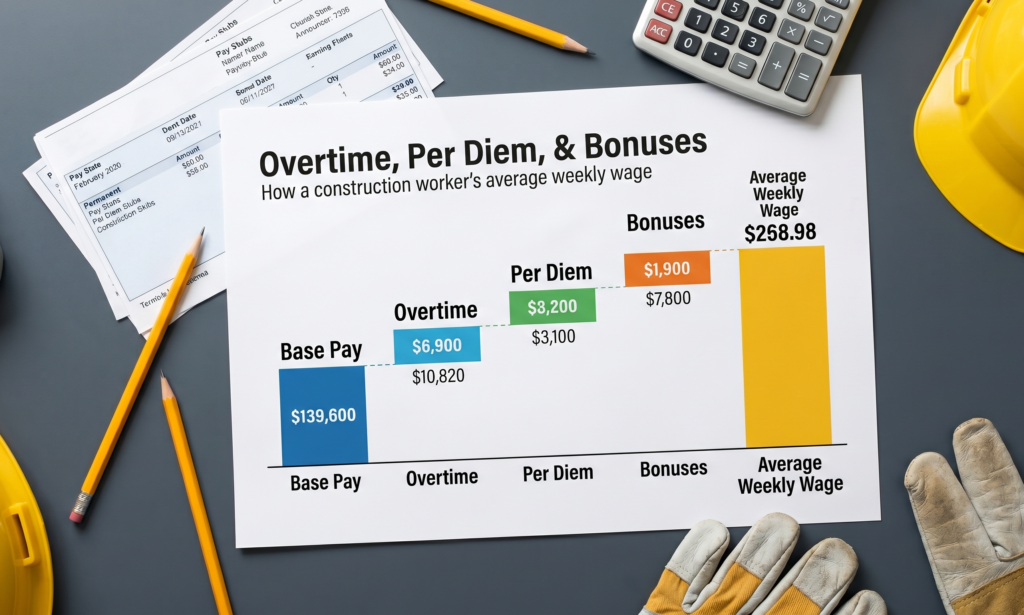
    Construction pay is rarely just a flat hourly rate. It moves with overtime, seasonal hours, second jobs, and project-based extras. Each of those moving parts is an opportunity for a carrier to calculate a lower AWW — and a worker who only checks the base rate may never notice.

    Standard guidelines suggest the AWW should reflect true earning capacity, not a stripped-down version of it. Here are the categories most often left out:

    Often excluded by the carrierWhy it frequently belongs in the AWW
    Overtime payFor trades that routinely work 50–60 hour weeks, overtime is real, recurring income — not a bonus.
    Per diem / travel allowancesIn many states, regular per diem that functions as wages may be includable rather than ignored.
    Bonuses and incentive payRecurring production or safety bonuses can form part of true average earnings.
    Second job / concurrent employmentSeveral states allow wages from a second job to be combined into one AWW.
    The value of fringe benefitsSome systems count the lost value of employer-paid health insurance or lodging.

    Insurer trick to watch for: A common tactic is to base the AWW on a single recent pay stub from a slow week, or to use only base hourly pay while quietly dropping overtime and per diem. Attorneys often recommend requesting a full year of earnings records and comparing the carrier’s figure line by line.

    The “Short Tenure” Trap

    Workers who were recently hired, or who work seasonally, are especially exposed. If a carrier divides a few weeks of low early-season earnings across a full period, the resulting AWW can look far below what the worker would realistically have earned over a normal year.

    Generally, in many states, the law provides alternative methods for these situations — such as using the wages of a comparable worker in the same trade, or annualizing seasonal earnings — precisely so a short or interrupted work history does not unfairly sink the number. Whether those methods apply, and exactly how, depends heavily on the state.

    For a broader walk-through of how the wage figure connects to the rest of the claims process, our complete guide to construction injury benefits covers each stage in plain language.

    Red Flags That Your AWW May Be Too Low

    No single sign proves the number was understated, but several together are worth a closer look:

    • The weekly check feels far smaller than two-thirds of your normal take-home pay for a busy week.
    • The carrier never asked for a full year of pay records.
    • Your overtime or per diem appears nowhere in their figure.
    • You held a second job that was never mentioned.
    • The AWW was based on a slow stretch of work rather than a representative period.

    Where Official Wage and Safety Data Fits In

    Understated wage figures often rely on a worker not knowing what their trade typically earns or what protections exist. Public agencies publish a great deal of free wage and safety information. The federal OSHA Workers’ Rights resource is one authoritative starting point for understanding the obligations employers carry on a jobsite, and many state labor departments publish prevailing wage data for construction trades.

    Pairing that public information with your own pay stubs and tax records creates a far stronger basis for checking the AWW than relying on the carrier’s number alone.

    How Workers Typically Verify the Number

    There is no single correct path, and the right one depends on the state and the trade. That said, attorneys often recommend a methodical approach rather than accepting the figure at face value:

    • Gathering all pay records — ideally a full 52 weeks, including overtime and per diem.
    • Asking the carrier in writing exactly how the AWW was calculated and what period it used.
    • Listing any concurrent employment that may be combinable in that state.
    • Checking whether a seasonal or short-tenure method should have applied instead.

    State laws vary significantly regarding the look-back period, which earnings count, and the deadlines to dispute a wage rate — in some states that window is measured in days, not months. Nothing here is legal or financial advice; it is general, informational background to help an injured worker ask better questions.

    See What Your Benefits May Actually Be Worth

    Before accepting any weekly rate, it helps to have an independent sense of where your AWW — and the benefits built on it — should realistically land. HardHat Rights offers a free, anonymous Benefits Estimator that walks through the same wage and value drivers insurers use, without asking for your name or signing you up for anything.

    Try the free, anonymous Benefits Estimator at HardHat Rights to see how your weekly check compares to what your real earnings suggest — and walk into your next conversation with the carrier informed instead of shortchanged.

  • Lowball Settlement Offers: How to Know if You’re Being Cheated


    Lowball Settlement Offers: How to Know if You’re Being Cheated

    After a serious jobsite injury, the first settlement number an insurance company puts in front of an injured construction worker is rarely the number their claim is actually worth. It is a starting position — one carefully calculated to close the file quickly and cheaply. Understanding how a lowball offer is built, and the warning signs that you may be looking at one, is one of the most important things a worker can do before signing anything.

    This article breaks down the mechanics behind underpriced offers, the pressure tactics adjusters lean on, and the value drivers that low offers conveniently ignore.

    What Counts as a “Lowball” Settlement?

    A lowball offer is a settlement proposal that falls meaningfully below the reasonable value of the claim — the value built from medical costs, lost wages, the degree of permanent impairment, and future treatment needs. The problem is that most workers have no baseline to compare against, so a five-figure check can feel generous even when it covers a fraction of the long-term cost.

    Generally, in many states, a workers’ compensation settlement is expected to account for several categories at once:

    • Past medical bills already incurred for the injury.
    • Future medical care, including surgeries, therapy, and medication that doctors anticipate.
    • Temporary disability — wages lost while unable to work.
    • Permanent disability or impairment, often tied to a physician’s rating.
    • Vocational rehabilitation, when an injury prevents a return to the same trade.

    When an offer is silent on future medical care or permanent impairment, that silence is frequently where the real money was removed.

    Insurer trick to watch for: A common tactic is to present a single lump sum without an itemized breakdown. With no line items, a worker cannot see that future surgery or a permanent impairment rating was valued at zero. Attorneys often recommend asking, in writing, exactly how the number was calculated.

    Why the First Offer Is Almost Always Low

    Insurance carriers are businesses, and every claim is a line item on their balance sheet. An early, low settlement serves the carrier in three ways: it closes the file before the full medical picture is known, it removes the risk of an expensive future surgery, and it resolves the claim while the worker is financially stressed and most likely to accept.

    Standard guidelines suggest that the moment of greatest financial pressure on an injured worker — the weeks right after wages stop — is precisely when the lowest offers tend to appear. That timing is not a coincidence.

    What the offer saysWhat it may actually mean
    This is our best and final offer.Often an opening anchor, not a true ceiling.
    You don’t need a lawyer for this.Represented workers statistically tend to recover more on average.
    Sign today and we’ll cut the check this week.Speed benefits the carrier; it rarely benefits the claimant.
    Your treatment is basically done.Future care may still be medically likely and compensable.

    Red Flags That an Offer May Be Underpriced

    No single sign proves a claim is being shortchanged, but several appearing together is a strong signal that the number deserves a closer look:

    1. The offer arrives before maximum medical improvement (the point where a doctor confirms the condition has stabilized) is reached.
    2. There is no itemized breakdown of how the figure was reached.
    3. The offer ignores a permanent impairment rating or pressures the worker to skip the rating exam entirely.
    4. The adjuster pushes an artificial deadline — “this expires Friday.”
    5. The paperwork quietly closes the right to future medical care in exchange for the lump sum.

    Deadline warning: State laws vary significantly regarding the time limits to dispute an offer, request a rating, or file a claim. In some states the window is measured in days, not months. Because a signed settlement is generally very difficult to reverse, attorneys often recommend confirming every applicable deadline before responding to any offer.

    The Role of Permanent Impairment Ratings

    For many construction injuries — a damaged shoulder, a fused spine, a crushed hand — the largest piece of a fair settlement is tied to the permanent impairment rating. This is a percentage a physician assigns to reflect lasting loss of function, and many state systems convert that percentage into a dollar value.

    Because the rating drives so much of the number, it is also where disputes concentrate. A carrier-selected doctor may issue a lower rating than an independent evaluation would. Generally, in many states, a worker has the option to seek a second opinion or contest a rating, though the exact process differs sharply from one state to the next.

    For a broader walk-through of how these pieces fit together across the claims process, our complete guide to construction injury benefits covers each stage in plain language.

    Where Official Safety and Wage Data Fits In

    Underpriced offers often lean on the assumption that a worker doesn’t know the full scope of their rights or the hazards involved in their trade. Public agencies publish a great deal of free information on workplace injury and worker protections. The federal OSHA Workers’ Rights resource is one authoritative starting point for understanding the safety obligations employers carry on a jobsite.

    Pairing that public information with your own medical records creates a far stronger foundation than relying on the carrier’s framing alone.

    How Workers Typically Respond to a Low Offer

    There is no single correct answer, and the right path depends heavily on the injury and the state. That said, attorneys often recommend a measured rather than reactive approach:

    • Requesting the calculation in writing rather than accepting a verbal figure.
    • Confirming whether maximum medical improvement has actually been reached.
    • Gathering complete medical documentation, including any anticipated future care.
    • Understanding how the local state system values permanent impairment before agreeing to a number.

    State laws vary significantly, and a strategy that fits a worker in one state may be entirely wrong in another. Nothing here is legal advice; it is general, informational background to help an injured worker ask better questions.

    Find Out What Your Claim May Actually Be Worth

    Before responding to any number, it helps to have an independent sense of the range your claim might fall into. HardHat Rights offers a free, anonymous Benefits Estimator that walks through the same value drivers insurers use — medical costs, lost wages, and impairment — without asking for your name or signing you up for anything.

    Try the free, anonymous Benefits Estimator at HardHat Rights to see how a settlement offer compares to the categories your claim may include — and walk into your next conversation with the carrier informed instead of pressured.

  • Delay Tactics: What to Do When Workers’ Comp Won’t Approve Your Surgery


    Delay Tactics: What to Do When Workers’ Comp Won’t Approve Your Surgery

    Your treating doctor says you need surgery. The pain is real, the diagnosis is clear, and yet weeks pass with no answer from the insurance company. If you are stuck in that silence, you are experiencing one of the most common and most damaging patterns in the entire claims process: the strategic delay. For an injured construction worker, a stalled surgery is not just a medical problem. It can quietly erode your recovery, your income, and the value of your claim.

    Here is what few people are told up front: a delay is often not an accident or a paperwork backlog. In many cases it is a predictable response that benefits the party paying the bills. Understanding why it happens is the first step toward keeping it in perspective.

    Why Insurers Delay Surgery Approvals

    To be clear, not every delay is deliberate, and many claims adjusters are simply overloaded. But the structure of the system creates a financial incentive to wait. A surgery is one of the largest single costs in a workers’ compensation claim, and every week it is postponed is a week the insurer holds onto that money.

    Several quiet motives can sit behind a stalled approval:

    • Cost containment. A delayed or denied surgery is a direct saving for the insurer’s bottom line.
    • Pressure to settle. A worker in pain and out of income may accept a lower settlement just to move forward.
    • Building a paper trail. Time creates room to schedule an exam or request records that might justify a denial later.
    • Hoping you give up. Some claims simply fade away when an exhausted worker stops following up.

    Insurer tactic to watch for: A common move is the “utilization review,” where a doctor who has never examined you reviews your file on paper and labels the recommended surgery “not medically necessary.” This single document can become the basis for a formal denial, even though your own surgeon disagrees.

    The Real Cost of Waiting

    A delay is rarely framed as a denial. It is presented as a routine review, a request for “just a few more records,” or a referral for a second opinion. That softer language hides a hard reality: time itself causes harm. Untreated injuries can worsen, temporary conditions can become permanent, and the longer you wait, the easier it becomes for an examiner to argue your problem is something other than your workplace injury.

    Meanwhile, the financial strain builds. Bills continue while wages stop, and that pressure is sometimes the entire point. Attorneys often describe this as the insurer trying to “starve out” a valid claim rather than fight it openly.

    Delay vs. Denial: Knowing the Difference

    FactorStrategic DelayFormal Denial
    What you receiveSilence or vague “still reviewing” repliesA written decision rejecting the surgery
    Your timelineOften no clear deadline givenAppeal deadlines usually start running
    The riskIndefinite waiting and worsening injuryLost benefits if the window is missed
    Common responseDocumented follow-up and written requestsFormal appeal or dispute process

    The distinction matters because the two situations are handled very differently. A delay can sometimes be pushed forward with persistent, written follow-up. A formal denial generally triggers strict appeal deadlines that, once missed, can be extremely difficult to reopen.

    Deadlines matter. State laws vary significantly regarding how long an insurer has to respond to a surgery request and how long you have to dispute a denial. In some states the response window is measured in days, not months. Attorneys often recommend treating any written denial as time-sensitive, because missing a deadline can cause more lasting damage than the delay itself.

    Approaches Injured Workers Commonly Consider

    While nothing here is legal advice, the following reflects how a stalled surgery claim is generally navigated. Standard guidelines suggest that documentation and persistence are the strongest forms of protection:

    1. Everything in writing. Generally, in many states, written requests and email confirmations create a record that a phone call cannot. A paper trail of unanswered requests can become powerful evidence.
    2. A clear surgeon’s recommendation. A detailed, specific note from your treating surgeon explaining why the procedure is necessary is often the strongest counterweight to a paper review.
    3. Tracking every date. Noting when the request was sent, when records were provided, and when responses arrived helps expose an unreasonable delay.
    4. Understanding state rules. Because deadlines and procedures differ so dramatically, knowing the specific rules of your state is generally considered essential.

    Federal safety standards do not govern these state benefit timelines, but they help establish what a safe jobsite and a properly reported injury should look like in the first place. You can review official worker protections directly at the U.S. Occupational Safety and Health Administration (OSHA).

    For a step-by-step walkthrough of how a construction claim moves from injury to resolution, our complete workers’ compensation guide breaks down each stage in plain language.

    Remember: A delay is a tactic, not a verdict. Recognizing it for what it is helps you keep the pressure where it belongs. State laws vary significantly, and the specifics of your situation always matter.

    See Where Your Claim Really Stands

    Waiting on a surgery you have already been told you need is one of the most stressful moments an injured worker can face, and the uncertainty alone is exhausting. Before you assume the delay is permanent, it helps to understand the potential value and direction of your claim. Try the free, anonymous Benefits Estimator at HardHat Rights to get a clearer picture of your situation in minutes, with no names and no pressure. Start your free Benefits Estimator here and take the guesswork out of what comes next.

  • The Nurse Case Manager: Helping You Heal, or Spying for the Insurance Company?


    The Nurse Case Manager: Helping You Heal, or Spying for the Insurance Company?

    At some point in a serious workers’ compensation claim, a friendly voice may call and introduce herself as your nurse case manager. She sounds caring. She asks how you are feeling, offers to help schedule appointments, and promises to make the whole process smoother. For an injured construction worker buried in paperwork and pain, that help can feel like a lifeline.

    Here is what most workers are never told up front: in many claims, the nurse case manager is hired and paid by the insurance company, not by you and not by your doctor. That single fact does not make her a villain, but it changes everything about how the relationship should be understood.

    What a Nurse Case Manager Actually Does

    A nurse case manager (sometimes called a “medical case manager”) is typically a licensed nurse assigned to coordinate the medical side of a workers’ comp claim. On paper, the role exists to keep your recovery organized. In practice, the job usually blends two very different missions:

    • Helping arrange and track your medical appointments and treatment.
    • Reporting back to the insurer on your condition, your progress, and your projected return to work.

    That second mission is the one that catches workers off guard. Every conversation, every appointment she attends, and every offhand comment can become information that flows back to the company deciding whether to pay or deny your benefits. Standard guidelines in many states allow this kind of coordination, which is exactly why it deserves attention rather than blind trust.

    Insurer tactic to watch for: A nurse case manager often becomes most active right after your treating doctor recommends surgery, extended therapy, or extended time off work. Her reports can shape whether that treatment is approved, delayed, or quietly cut short.

    The “Two Hats” Problem

    The core tension is simple. The nurse wears two hats at once: a caregiver’s hat and a cost-control hat. To be fair, many case managers are skilled professionals who genuinely smooth out a chaotic process. The problem is structural, not personal. When the insurer signs the paycheck, the quiet incentive leans toward containing costs and shortening claims.

    This is why the same helpful behaviors can work against an injured worker:

    1. Attending your doctor visits. She may ask to join you in the exam room, where she can steer the conversation toward a faster return to work.
    2. “Updating” your doctor. She may relay the insurer’s preferences about light duty or treatment limits before your doctor decides.
    3. Casual check-in calls. Friendly questions about your weekend, your chores, or your “good days” can end up documented as evidence that you are less limited than you are.
    4. Pushing the timeline. Gentle pressure to return to work sooner can appear long before your body is ready.

    The Helpful Side vs. The Reporting Side

    What It Looks LikeThe Helpful SideThe Reporting Side
    Scheduling appointmentsSaves you time and phone callsTracks delays and missed visits
    Joining doctor visitsHelps explain medical termsInfluences return-to-work notes
    Friendly phone callsEmotional support and answersNotes on your daily activity level
    Who pays herTypically the insurance company

    The Doctor’s Office Boundary Workers Often Forget

    One of the most sensitive moments is when a nurse case manager asks to be present inside the exam room during your appointment. Many workers assume this is simply required. In reality, the rules around private medical conversations vary widely.

    State laws vary significantly here. In some states, a worker generally has the right to ask that a case manager wait in the lobby and speak with the doctor separately, rather than sit in on the private exam. In other states the rules are different. Attorneys often recommend confirming your local rights before assuming you have no say.

    The exam room is where decisions about your restrictions and return to work are shaped. Understanding who is allowed to be in that room, and in what role, is generally considered an important part of protecting a claim.

    Approaches Injured Workers Commonly Consider

    While nothing here is legal or medical advice, the following reflects how the process is generally navigated. Standard guidelines suggest that awareness and consistency are the strongest forms of protection:

    • Polite professionalism. Treating the case manager courteously while remembering she is part of the claims process, not part of your personal care team.
    • Honest consistency. Describing your symptoms the same way to everyone tends to protect credibility far more than minimizing or exaggerating them.
    • Careful casual talk. Many attorneys note that “small talk” about activities, hobbies, or chores can reappear later in a written report.
    • Knowing your state’s rules. Because procedures differ so dramatically, understanding your local rights about exam-room presence and medical privacy is generally considered essential.

    Federal workplace-safety standards do not govern these state benefit rules, but they help define what a safe jobsite and a fair injury response should look like. You can review official worker protections directly at the U.S. Occupational Safety and Health Administration (OSHA).

    For a broader walkthrough of how a construction claim moves from injury to resolution, our complete workers’ compensation guide explains each stage in plain language.

    Remember: A nurse case manager can be genuinely useful, but she is not neutral when the insurer pays her. Knowing what she is there to do is the first step toward keeping the relationship in perspective. State laws vary significantly, and the specifics of your situation always matter.

    See Where You Stand Before Your Next Call

    If a nurse case manager has entered your claim, you are likely at a stage where the decisions ahead carry real weight, and the uncertainty is exhausting. Before your next appointment or phone call, it helps to understand the potential value and direction of your claim. Try the free, anonymous Benefits Estimator at HardHat Rights to get a clearer picture of your situation in minutes, with no names and no pressure. Start your free Benefits Estimator here and take the guesswork out of what comes next.

  • Pre-Existing Conditions: The #1 Excuse Insurers Use to Deny Construction Claims


    Pre-Existing Conditions: The #1 Excuse Insurers Use to Deny Construction Claims

    You hurt your back lifting on the jobsite. The pain is real, the timing is clear, and you filed your claim. Then the denial letter arrives with two words that seem to erase everything: “pre-existing condition.” For injured construction workers, this is the single most common reason insurers give for cutting off benefits, and it is also one of the most widely misunderstood.

    Here is what almost no one explains: a prior injury, an old surgery, or even normal wear-and-tear in your spine does not automatically disqualify you from workers’ compensation. In many states, the law was written with exactly this situation in mind.

    Why Insurers Reach for the “Pre-Existing” Label So Often

    Construction is hard on the body. After years of lifting, climbing, and repetitive strain, very few workers have a “perfect” medical history. Insurers know this. When they pull your old medical records, they are frequently looking for any prior mention of the same body part, even a minor complaint from a decade ago.

    The strategy is simple: if they can argue your pain comes from an old problem rather than a recent workplace injury, they may be able to deny the claim entirely or sharply reduce what they pay. Attorneys often describe this as shifting the blame from the jobsite to your past.

    Insurer tactic to watch for: A single line in a years-old doctor’s note, such as “occasional lower back stiffness,” can be presented as proof that your current injury is “not work-related.” One sentence, taken out of context, is sometimes treated as if it settles the entire claim.

    The Legal Idea That Often Protects You: Aggravation

    This is the part insurers rarely highlight. In many states, the law draws a critical distinction between causing an injury and aggravating one. Generally, if a workplace incident makes an existing condition worse, accelerates it, or turns a manageable problem into a disabling one, that aggravation may itself be a compensable injury.

    There is also a long-standing legal principle attorneys frequently reference, sometimes called the “eggshell” rule: an employer generally takes a worker as they find them. In plain terms, the fact that your body was more vulnerable to injury does not automatically excuse the employer’s insurer from covering a work-related aggravation.

    • New injury: A condition that did not exist before the workplace incident.
    • Aggravation: An older condition made measurably worse by work.
    • Recurrence: A genuine flare-up of an old injury with no new workplace cause, which is generally harder to claim.

    The difference between these categories is where most disputes live, and it is rarely as obvious as an insurer suggests.

    Denial vs. Reality: A Quick Comparison

    What the Insurer SaysWhat the Law Often Recognizes
    You had back problems before.A work injury that worsens an old condition may still be covered.
    This is just normal aging/degeneration.Work that accelerates degeneration can qualify as an aggravation.
    Your old records prove it isn’t work-related.The key question is what changed after the workplace incident.
    You never reported pain here before.A previously stable condition becoming disabling can be compensable.

    How These Denials Actually Happen

    The denial is rarely a dramatic accusation. More often it is built quietly from your own paperwork. Insurers commonly rely on a few recurring moves:

    1. Mining old medical records. Any prior reference to the injured body part may be flagged, no matter how minor or how long ago.
    2. Leaning on an IME opinion. An insurer-selected exam may conclude your symptoms reflect “pre-existing degenerative changes” rather than a workplace event.
    3. Exploiting gaps in your story. If your description of the injury shifts between the report, the doctor, and the adjuster, that inconsistency can be used against you.
    4. Counting on you to give up. Many valid claims are abandoned simply because the worker assumes the word “pre-existing” is the final answer.

    Deadlines matter. State laws vary significantly regarding how long you have to appeal a denial or request a second opinion, and the window is sometimes measured in days. Attorneys often recommend treating any “pre-existing condition” denial as something to review immediately, because a missed appeal deadline can be far more final than the denial itself.

    Approaches Injured Workers Commonly Consider

    While nothing here is legal advice, the following reflects how this situation is generally navigated. Standard guidelines suggest that clear documentation is the strongest form of protection:

    • Describing the change honestly. The decisive question is usually how your condition differed before and after the workplace incident, so consistency on that point tends to matter most.
    • A clear treatment record. A detailed account from your treating doctor explaining how work aggravated the condition is often the most effective counter to a denial.
    • Full transparency about your history. Attorneys frequently note that hiding a prior injury tends to damage credibility far more than the prior injury itself ever could.
    • Knowing the rules of your state. Because aggravation standards and deadlines differ so dramatically, understanding your local rules is generally considered essential.

    Federal workplace-safety standards do not govern these state benefit rules, but they establish what a safe jobsite should look like and how injuries should be recorded. You can review official employer recordkeeping and injury obligations directly at the U.S. Occupational Safety and Health Administration (OSHA).

    For a broader walkthrough of how a construction claim moves from injury to resolution, our complete workers’ compensation guide breaks down each stage in plain language.

    Remember: “Pre-existing condition” is an argument, not a verdict. The fact that you were not in perfect health before your injury does not erase what happened to you at work. State laws vary significantly, and the specifics of your situation always matter.

    See Where You Stand Before You Accept a Denial

    A denial built on your medical history can feel impossible to fight, and the stress of wondering whether you have any case at all is exhausting. Before you assume the insurer is right, it helps to understand the potential value and direction of your claim. Try the free, anonymous Benefits Estimator at HardHat Rights to get a clearer picture of your situation in minutes, with no names and no pressure. Start your free Benefits Estimator here and take the guesswork out of what comes next.

  • “Light Duty” Illusions: How Return-to-Work Programs Can Be Used Against You


    “Light Duty” Illusions: How Return-to-Work Programs Can Be Used Against You

    After a serious jobsite injury, a phone call often arrives sooner than expected. The employer has “good news”: a light-duty position is available, and the worker is invited back. On the surface it sounds like compassion and a path back to normal life. Beneath the surface, a return-to-work offer can quietly become one of the most financially decisive moments in an entire workers’ compensation claim.

    The reason is simple. Once a worker accepts or refuses light duty, the dollar value of their benefits can shift dramatically. Generally, in many states, that single decision influences how much wage-replacement money continues to flow, and for how long.

    What “Light Duty” Actually Means in a Comp Claim

    Light duty refers to modified or restricted work that a treating physician approves while an injured worker is still recovering. In construction, this might mean trading framing or demolition for tasks like answering phones, monitoring a gate, sorting paperwork, or watching a tool crib. The pay is sometimes lower, the hours sometimes fewer, and the role often unrelated to the trade the worker spent years mastering.

    On paper, return-to-work programs exist to help recovery and keep skilled workers connected to their employer. Standard guidelines suggest gradual reintegration can be genuinely beneficial. The problem is that the same program can be steered by an insurer to reduce or terminate benefits, regardless of whether the worker has truly healed.

    Insurer tactic to watch for: A light-duty offer frequently appears right after wage-loss checks begin, or just before an expensive treatment is approved. The timing is rarely accidental. Once “suitable” work is offered, the insurer may argue that full wage-replacement benefits are no longer owed.

    Why a Friendly Offer Can Carry Hidden Consequences

    To be fair, many employers offer light duty in good faith. The risk is structural, not always personal. In most state systems, wage-loss benefits are tied to what a worker is able to earn. The moment a job is labeled “available and suitable,” the math behind those benefits can change, even if the worker never actually performs the role comfortably.

    Several features of light-duty programs make them easy to misuse:

    1. The “suitable work” label is powerful. Once a position is deemed suitable, refusing it can be treated as voluntarily giving up benefits.
    2. The job may be designed to fail. Some assignments quietly exceed medical restrictions, hoping the worker quits or reinjures the same body part.
    3. “Make-work” positions can vanish. A made-up role can disappear once benefits are reduced and the paperwork is settled.
    4. Wage gaps may go unpaid. If light duty pays less than the original wage, the difference is not always automatically covered.

    Full Wage Benefits vs. Light-Duty Earnings: A Quick Comparison

    FactorOff Work on BenefitsAccepting Light Duty
    Wage replacementOften a set portion of full wagesMay drop to a partial “wage-loss” amount
    Physical riskTime to heal under doctor’s carePossible strain if duties exceed limits
    Employer leverageLower while you remain off workHigher once “suitable work” exists
    Refusal consequencesNot applicableRefusing “suitable” work may cut benefits

    How a Light-Duty Offer Can Quietly Shrink a Claim

    The damage is rarely announced. More often it appears in the language of a letter: the worker has been “released to modified duty,” a “suitable position” has been “made available,” and benefits are being “adjusted accordingly.” Each phrase sounds procedural, yet together they can cut a wage-loss check substantially or end it entirely.

    There is also a subtler trap. If a worker attempts light duty and the body simply cannot tolerate it, walking away without documentation can later be characterized as quitting rather than being medically unable to continue. The distinction matters enormously, and it often hinges on what the treating doctor recorded at the time.

    Deadlines and rules matter. State laws vary significantly regarding what counts as a “suitable” offer, how restrictions are verified, and how quickly a worker may respond. In some states the response window is measured in days. Attorneys often recommend that any return-to-work letter be reviewed against the treating physician’s written restrictions before anything is signed.

    Approaches Injured Workers Commonly Consider

    Nothing here is legal or medical advice, and the right path depends heavily on the state and the specific injury. That said, the following reflects how this situation is generally navigated:

    • Comparing the offer to the restrictions. Many attorneys recommend lining up the written job duties against the doctor’s documented limits, line by line.
    • Keeping everything in writing. Standard guidelines suggest that verbal offers and verbal complaints are far weaker than a clear paper trail.
    • Reporting problems promptly. Generally, in many states, telling the treating provider when a light-duty task causes pain helps separate “unable to continue” from “quit.”
    • Understanding the local definition of “suitable.” Because that single word controls so much money, its state-specific meaning is often considered essential to understand.

    Federal safety rules do not set these state benefit amounts, but they do define what employers owe workers on a jobsite in the first place. Official obligations can be reviewed directly at the U.S. Occupational Safety and Health Administration (OSHA).

    For a step-by-step view of how a construction claim moves from injury to resolution, our complete workers’ compensation guide explains each stage in plain language.

    Remember: A return-to-work offer is part of the claims process, not a favor with no strings attached. Understanding what “light duty” and “suitable work” mean in your state is the first step toward keeping a friendly phone call from quietly reshaping your benefits. State laws vary significantly, and the details of your situation always matter.

    See What Your Claim May Really Be Worth First

    A light-duty offer can feel like pressure to decide before you understand what is at stake, and that uncertainty is draining. Before responding to any return-to-work letter, it helps to see the potential value and direction of your claim. Try the free, anonymous Benefits Estimator at HardHat Rights to get a clearer picture in minutes, with no names and no pressure. Start your free Benefits Estimator here and take the guesswork out of what comes next.

  • Workers’ Comp Surveillance: Are Insurance Investigators Watching You?

    Workers’ Comp Surveillance: Are Insurance Investigators Watching You?

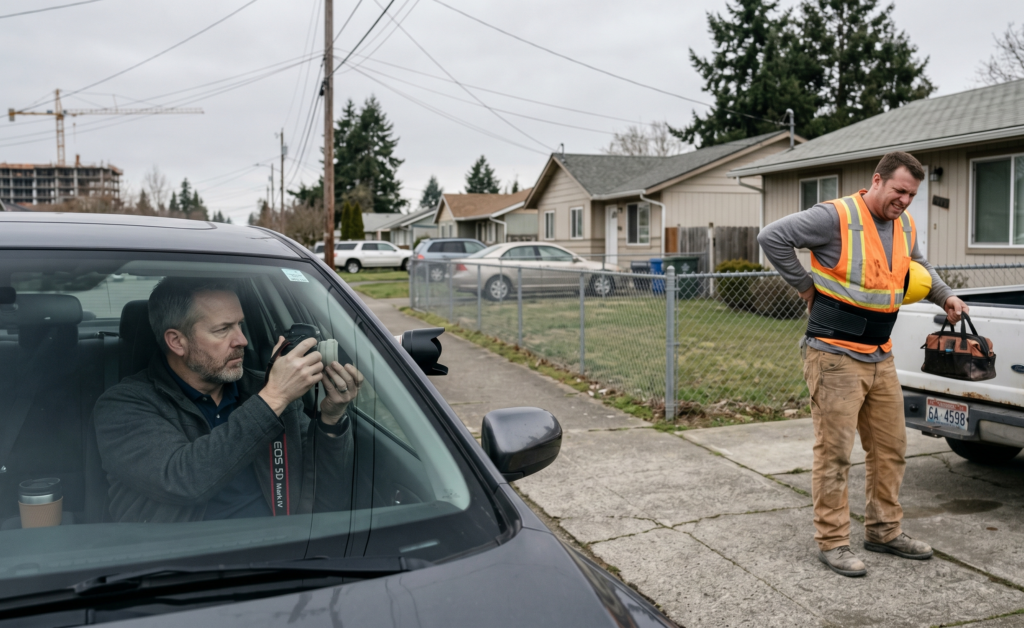
    If you have filed a workers’ compensation claim after a jobsite injury, there is a real possibility that someone you have never met is paying close attention to your daily movements. Surveillance is one of the most common — and least discussed — tools used by insurance carriers to dispute construction injury claims. It is rarely dramatic, and it is almost never announced. For an injured worker already dealing with pain, lost wages, and uncertainty, the idea of being watched can feel both invasive and frightening.

    This guide explains, in plain terms, how workers’ comp surveillance generally works, why insurers use it, and what injured construction workers should understand about protecting the integrity of an honest claim.

    Why Would an Insurer Put You Under Surveillance?

    Insurance carriers are businesses, and every approved claim is a cost on their books. Surveillance is generally used not to confirm that a worker is hurt, but to look for any moment that can be framed as inconsistent with the reported injury. In many cases, the goal is to build a file that creates doubt.

    Investigators are typically assigned when a claim shows one or more of the following characteristics:

    • High-value claims involving surgery, long-term disability, or permanent impairment.
    • Soft-tissue or back injuries that do not always appear obvious on imaging.
    • Claims where the worker is expected to be off the job for an extended period.
    • Any perceived inconsistency between the injury described and the worker’s reported activity.
    • Disputes over whether the injury is truly work-related.

    Insider tactic: Carriers often schedule surveillance around medical appointments, independent medical exams (IMEs), and depositions — moments when they know exactly where you will be and when.

    Common Surveillance Tactics Investigators Use

    Surveillance in workers’ comp cases is generally broader than most people expect. It is not limited to a single person sitting in a parked car. Standard guidelines within the investigation industry typically include a mix of physical observation and digital research.

    Surveillance TypeWhat It Typically Involves
    Physical surveillanceAn investigator follows or films a claimant in public — running errands, leaving the house, lifting groceries, or doing yard work.
    Video documentationLong-lens recording from a public street, often capturing short clips that are later edited into a timeline.
    Social media reviewExamination of public posts, photos, check-ins, and tagged content across platforms.
    Activity checksInvestigators may visit a worker’s neighborhood, gym, or even pose as someone making casual conversation.
    Records researchPublic databases, prior claims history, and online footprint used to build a profile.

    Social Media: The Surveillance You Hand Over Freely

    For modern construction injury claims, social media has become the single easiest source of damaging material for an insurer. A photo posted to be polite — smiling at a family barbecue, holding a child, standing at a wedding — can be stripped of all context and presented as proof that an injury is exaggerated.

    The danger is rarely about dishonesty. It is about how a single frozen image can be misread. A worker who pushed through severe pain for one ten-second photo may appear, on screen, to be perfectly fine.

    Generally, in many states, anything posted publicly online can be reviewed and potentially introduced as evidence. Attorneys often recommend that claimants treat their online presence as if a carrier is already watching — because, frequently, it is.

    Is Workers’ Comp Surveillance Even Legal?

    This is one of the most common questions injured workers ask, and the answer is generally yes — within limits. Investigators are typically permitted to observe and record a person in public spaces where there is no reasonable expectation of privacy. What they are generally not permitted to do is trespass onto private property, record inside your home, intercept private communications, or misrepresent themselves in ways that cross into harassment.

    It is important to understand that state laws vary significantly regarding privacy, recording consent, and what surveillance evidence is admissible. The rules that apply in one state may be very different just across the border. Workers seeking the federal baseline on jobsite safety and worker protections can review official guidance published by the U.S. Occupational Safety and Health Administration (OSHA).

    Warning: Because surveillance evidence is generally legal when gathered in public, the strongest protection an honest claimant has is consistency — making sure that what is reported to a doctor matches real, day-to-day physical limits.

    How Honest Workers Get Misrepresented

    The most damaging surveillance is rarely a “gotcha” moment. More often, it is the “snapshot” trick: an investigator captures a few seconds of normal movement and presents it as if it represents the worker’s entire condition.

    1. A worker reports being unable to perform heavy lifting on a jobsite.
    2. Footage shows that same worker briefly carrying a light bag of groceries.
    3. The carrier argues the two are contradictory — even though they are not medically comparable.

    This is why detailed, honest medical documentation matters so much. For a full breakdown of how to keep an injury claim consistent and protected from these tactics, our complete workers’ compensation guide walks through each stage of the process.

    Signs You May Be Under Surveillance

    Surveillance is designed to be invisible, but injured workers sometimes notice subtle patterns. While none of these confirm anything on their own, they are commonly reported:

    • The same unfamiliar vehicle parked near your home on multiple days.
    • A stranger who seems to appear at locations tied to your appointments.
    • Unusual friend requests or messages from accounts you do not recognize.
    • A sudden increase in carrier questions about your daily activities.

    Generally, the most reassuring fact for an honest claimant is simple: surveillance only becomes a problem when there is a gap between what is reported and what is true. Accurate, consistent reporting is the strongest defense.

    Find Out What Your Construction Injury Claim Could Be Worth

    Understanding whether you are being watched is only one piece of protecting your rights. The next step is knowing the real potential value of your workers’ comp claim — before a carrier tries to define it for you.

    You can use our free, anonymous Benefits Estimator at HardHat Rights to get a confidential, no-pressure estimate of what your construction injury claim may be worth. It takes only a few minutes, requires no personal contact information to begin, and helps you walk into your claim informed instead of outmatched.

    HardHat Rights provides general information for educational purposes and is not a substitute for advice from a licensed attorney in your state. Because workers’ compensation laws differ significantly from state to state, individual cases may vary.

  • The Phone Call That Can Quietly Wreck Your Workers’ Comp Claim

    The Phone Call That Can Quietly Wreck Your Workers’ Comp Claim

    A few days after a construction injury, the phone rings. The voice is calm, friendly, and sounds like it’s on your side. The insurance adjuster says they just need a quick recorded statement to “get your benefits moving faster.” It feels routine. It feels harmless.

    It is not. Agreeing to that recorded statement without preparation is one of the most damaging moves an injured worker can make — and most people never realize it until the denial letter shows up. The recording is not gathering your story to help you. It is gathering evidence that can be used to reduce or deny your claim.

    What a Recorded Statement Actually Is

    A recorded statement is an interview — usually over the phone — where an insurance company representative asks you questions about your injury, your job, your medical history, and how the accident happened. Every word is recorded and transcribed. It becomes a permanent part of your claim file.

    Generally, in many states, you are not legally required to give a recorded statement to the insurance company at the early stage of a claim. Many workers assume it’s mandatory because of how the request is framed. It usually is not. Standard guidelines suggest treating any request to be recorded as a formal legal step, not a casual phone chat.

    Insurer Trick: Adjusters are trained to call soon after the injury — while you’re medicated, in pain, and stressed. A foggy, exhausted answer can sound like an inconsistency later, even when you’re telling the truth.

    Why It’s Such a Costly Mistake

    The danger isn’t that you’ll lie. The danger is that honest, off-the-cuff answers get twisted into reasons to pay you less. Here’s how a friendly conversation becomes ammunition:

    • Minimizing your pain: If you politely say “I’m doing okay,” that phrase can later be quoted to argue your injury isn’t serious.
    • Guessing on the record: Saying “I think it was around 10 a.m.” when you’re unsure creates a “fact” that may clash with other records.
    • Pre-existing conditions: A casual mention of an old ache can be used to claim your injury wasn’t caused by work at all.
    • Describing duties loosely: Understating or overstating what you do on site can affect how your wage benefits are calculated.
    • Speculating about fault: Workers’ comp is generally a no-fault system, but a stray comment like “I should’ve been more careful” can still muddy the file.

    Recorded Statement: What’s Often Safe vs. What’s Risky

    Information TypeGenerally Lower RiskOften High Risk
    Your identityName, job title, employer
    The injuryBasic confirmation an injury occurred at workDetailed guesses about cause, speed, or angle
    Your conditionI’m following my doctor’s careI feel fine,” “It’s not that bad,” pain ratings
    Medical historyOff-hand mentions of old injuries or conditions
    Timeline & factsWhat you clearly rememberAnything you have to guess at

    What People Often Do Instead

    Workers who protect their claims usually slow the process down before agreeing to anything recorded. Attorneys often recommend a few common-sense habits:

    1. Pause before agreeing. It’s generally acceptable to say you’d like to schedule the call for a later time rather than speak on the spot.
    2. Confirm what’s required. Standard guidelines suggest asking, in writing, whether a recorded statement is actually mandatory under your state’s rules.
    3. Stick to what you know. “I don’t recall exactly” is an honest, complete answer — guessing is what creates problems.
    4. Get help first. Attorneys often recommend speaking with a professional before any recording, not after a denial.

    Deadline Warning: Protecting yourself from a recorded statement does not pause your claim deadlines. Many states require that the injury be reported to your employer within a strict window — sometimes just a few days. Missing that notice deadline can sink an otherwise strong claim.

    For a full walkthrough of the claims process from injury to benefits, our complete construction injury guide breaks down each step in plain language.

    State Laws Change Everything

    There is no single national workers’ comp law. Rules on recorded statements, reporting deadlines, and benefit amounts vary significantly from one state to the next. What’s optional in one state may carry different consequences in another. Because of this, general information — including this article — cannot replace guidance tailored to where you live and work.

    For official, neutral background on worker rights and employer safety obligations, the U.S. Occupational Safety and Health Administration is a reliable starting point: OSHA’s Workers’ Rights resource.

    Know Where You Stand Before You Say a Word

    Before you ever pick up that adjuster’s call, it helps to understand what your claim could actually be worth — so a lowball offer or a twisted quote can’t catch you off guard. You can find out privately, with no phone call and no pressure.

    Use the free, anonymous Benefits Estimator at HardHat Rights to get a clearer picture of your potential benefits in minutes. No name, no recording, no commitment — just information that puts the power back in your hands.

  • The IME Trap: Why the “Independent” Medical Exam Is Rarely Independent


    The IME Trap: Why the “Independent” Medical Exam Is Rarely Independent

    If you have an open workers’ compensation claim, sooner or later a letter may arrive ordering you to attend an Independent Medical Examination (IME). The word “independent” sounds neutral, even reassuring. In practice, it is one of the most misunderstood and consequential moments in the entire claims process for injured construction workers.

    Here is the part most people are never told: the doctor performing your IME is generally not your doctor, and is frequently selected and paid for by the insurance company. That single fact changes how the exam should be understood.

    What an “Independent” Medical Exam Actually Is

    An IME is a one-time evaluation performed by a physician who has never treated you and will not continue your care. The exam usually exists to answer questions the insurer wants resolved, such as:

    • Whether your injury is genuinely work-related.
    • Whether you have reached “maximum medical improvement” (MMI).
    • Whether the treatment your own doctor recommends is “necessary.”
    • Whether you can return to work, and under what restrictions.

    The label “independent” refers to the idea that the physician is not your treating provider. It does not mean the physician is neutral toward the party paying the bill. Standard guidelines and many state systems acknowledge this tension openly, which is exactly why the exam deserves careful attention rather than blind trust.

    Insurer tactic to watch for: An IME is sometimes scheduled shortly after your treating doctor recommends surgery, extended therapy, or a higher disability rating. The timing is rarely a coincidence. A contrary IME opinion can become the basis for denying or reducing benefits.

    Why the Exam Often Tilts Toward the Insurance Company

    To be clear, many examining physicians are competent professionals. The problem is structural, not personal. When the same insurers and law firms refer cases to the same doctors repeatedly, a quiet incentive forms: opinions that favor the paying party tend to generate more referrals. Attorneys often describe this as the “frequent flyer” pattern.

    Several features of the IME make it easy to undervalue a real injury:

    1. The exam is brief. A complex back or shoulder injury may be assessed in only a few minutes.
    2. There is no ongoing relationship. The physician sees a snapshot, not the full history of your recovery.
    3. Casual conversation can be recorded. Offhand comments about hobbies, chores, or “good days” may appear in the report as evidence that you are less limited than you are.
    4. Surveillance sometimes accompanies the exam. Generally, in many states, insurers may pair an IME with video monitoring of physical activity.

    Treating Doctor vs. IME Doctor: A Quick Comparison

    FactorYour Treating DoctorIME Doctor
    RelationshipOngoing care over timeSingle, one-time visit
    Who paysYour claim / health coverageTypically the insurer
    Primary goalHelp you recoverAnswer the insurer’s questions
    Knowledge of your caseFull medical historyLimited snapshot

    How the IME Report Can Quietly Reduce Benefits

    The danger is rarely a dramatic accusation that you are faking. More often, the report uses careful, clinical language that chips away at the value of your claim. Phrases that frequently appear include “no objective findings,” “symptom magnification,” “pre-existing degenerative changes,” or “capable of light-duty work.”

    Each of these can become a tool to cut off treatment, push an early return to work, or lower a disability rating. Because the report carries the authority of a physician, it can be difficult to counter without a strong, well-documented record from your own treating provider.

    Deadlines matter. State laws vary significantly regarding how long you have to dispute an IME finding or request a second opinion. In some states the window is measured in days, not weeks. Attorneys often recommend reviewing any IME-based denial immediately, because missing a response deadline can be far more damaging than the report itself.

    Approaches Injured Workers Commonly Consider

    While nothing here is legal advice, the following reflects how the process is generally navigated. Standard guidelines suggest that preparation and documentation are the strongest forms of protection:

    • Honest consistency. Describing symptoms the same way you have all along tends to protect credibility more than minimizing or exaggerating.
    • A clear treatment record. A detailed, ongoing record from your treating doctor is often the most effective counterweight to a brief IME opinion.
    • Awareness of the setting. Many attorneys remind clients that the exam is part of the claims process, not part of their care.
    • Knowing the rules of your state. Because procedures differ so dramatically, understanding your local deadlines is generally considered essential.

    Federal workplace-safety standards do not govern these state benefit rules, but they help establish what a safe jobsite should look like in the first place. You can review official employer obligations directly at the U.S. Occupational Safety and Health Administration (OSHA).

    For a broader walkthrough of how a construction claim moves from injury to resolution, our complete workers’ compensation guide breaks down each stage in plain language.

    Remember: The IME is one opinion in a larger record, not a final verdict. Understanding what it is designed to do is the first step toward keeping it in perspective. State laws vary significantly, and the specifics of your situation always matter.

    See Where You Stand Before Your Next Step

    An IME letter can feel like the moment the insurance company starts working against you, and the uncertainty is exhausting. Before you assume the worst, it helps to understand the potential value and direction of your claim. Try the free, anonymous Benefits Estimator at HardHat Rights to get a clearer picture of your situation in minutes, with no names and no pressure. Start your free Benefits Estimator here and take the guesswork out of what comes next.