Motor Vehicle Accidents on the Construction Site: Who Actually Pays?
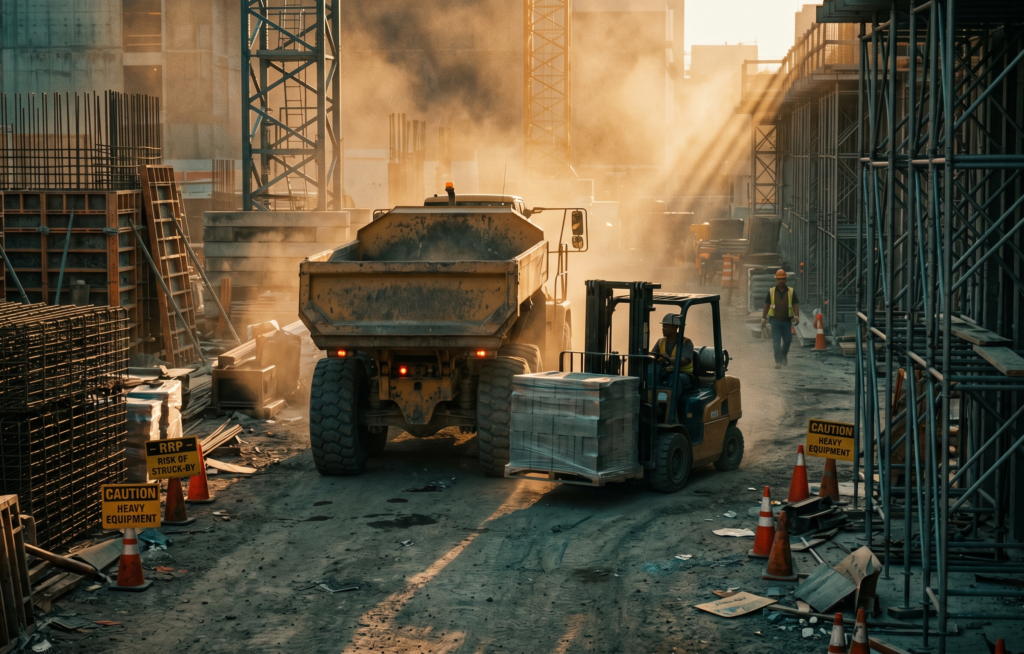
A construction site is one of the few workplaces where moving vehicles and people on foot share the same ground all day long. Dump trucks back up, forklifts cut across active zones, delivery drivers roll in from the public road, and pickups weave between materials. When two of those worlds collide, the injuries are often severe — and the very first question that follows is rarely about medicine. It is about money: who pays for this?
The honest answer is that a jobsite vehicle accident can open more than one source of compensation at the same time, and the insurers involved are not in a hurry to explain that. Knowing which doors may be open is what separates a worker who recovers a fraction of their losses from one who recovers the full picture.

Why “Who Pays” Is More Complicated Here Than a Normal Car Crash
On a public highway, a car crash usually has one payer: the at-fault driver’s auto insurance. A construction site scrambles that simple picture. The same accident can sit inside the workers’ compensation system and inside the auto-liability system at once, because a jobsite vehicle crash usually involves a worker who was on the clock when it happened.
That overlap is the key. When you are injured while working, workers’ comp generally responds regardless of who was at fault. But if the vehicle that hurt you was driven by someone other than your direct employer, a separate fault-based claim may exist alongside your comp claim — and that second claim can reach losses comp was never built to cover.
The distinction that controls everything: Workers’ comp is no-fault — it pays because you were hurt at work, not because someone was careless. A third-party auto claim is fault-based — it pays because a specific driver or company caused the crash. The two are not the same money, and one does not cancel the other.
The Four Common Scenarios — and the Payer Behind Each
Most jobsite vehicle accidents fall into a handful of patterns. Standard guidelines suggest the likely source of compensation shifts dramatically depending on who was driving and who they worked for.
| What Happened | Likely Payer(s) | Why |
|---|---|---|
| Struck by a co-worker’s vehicle or equipment | Workers’ comp | An employer and co-workers are generally shielded from being sued directly. |
| Hit by a delivery, trucking, or outside contractor’s vehicle | Comp and a third-party claim | The outside company is not your employer, so fault-based damages may apply. |
| Injured by a member of the public driving through or near the site | Comp and the driver’s auto insurance | A public driver is a classic third party with their own liability coverage. |
| Crash while driving for work off-site (errand, material run) | Comp, plus possible auto claims | Travel in the course of work is often covered, and another driver may be at fault. |
The pattern is consistent: the moment a vehicle from outside your own employer is involved, the chance of a second, larger claim rises sharply.
Why the Second Claim Can Be Worth Far More
Workers’ comp is fast but limited by design. A third-party auto claim, because it rests on someone’s fault, can generally pursue the full range of damages the law allows. The two recover fundamentally different things.
- Medical bills — comp typically covers approved treatment; a third-party claim can also pursue future care.
- Lost wages — comp usually pays a partial percentage, while a third-party claim may pursue full lost earnings.
- Pain and suffering — generally unavailable under comp, but frequently recoverable in a third-party case.
- Loss of future earning ability — limited and formula-based under comp, often fully recoverable through a fault claim.
Attorneys often describe the two as running on parallel tracks: comp keeps you afloat immediately, while the third-party claim addresses the broader human and financial cost the crash left behind.
How Safety Rules Build the Fault Case
A third-party claim rarely succeeds on frustration alone. It is generally built on whether a recognized safety standard was broken. Jobsite traffic is heavily regulated precisely because vehicle-versus-worker accidents are so often catastrophic, and those federal rules create a clear baseline for what responsible companies are expected to do.
When a backup alarm was disabled, a spotter was missing, a work zone lacked barriers, or a driver was untrained, that lapse can become powerful evidence of negligence. You can review the federal standards covering jobsite traffic control and struck-by hazards directly through the U.S. Occupational Safety and Health Administration (OSHA), the agency that publishes and enforces them.
Insurer tactic to watch for: After a serious vehicle accident, the at-fault company sometimes moves quickly to repair the vehicle, reset the work zone, or “clean up” the scene before the dangerous condition is documented. Once the layout, the skid marks, or the disabled alarm are gone, proving what failed becomes far harder. Attorneys often emphasize how decisive the first days after a crash can be.
The Workers’ Comp Lien: Why the Claims Are Connected
There is one link that surprises most workers. When a third-party claim succeeds, the workers’ comp insurer that already paid your medical bills and wage benefits may be entitled to be repaid out of that recovery. This is known as a comp lien or subrogation interest.
This does not make a third-party claim pointless — far from it. It means the two cases generally have to be evaluated together, because how the lien is reduced can significantly affect what you ultimately keep. The way these liens are calculated is highly state-specific, which is one reason these crashes are rarely navigated alone.
Deadlines and State Rules That Can End a Case Early
This is where strong claims quietly die. A comp claim and a third-party auto claim run on completely different clocks. The deadline to report a comp injury may be measured in days, while the deadline to file a fault-based negligence claim — the statute of limitations — is generally measured in years. Missing either one is usually permanent.
State laws vary significantly. Filing deadlines, the rules on shared fault, the size of the comp lien, and even which parties can be pursued change dramatically from one state to the next. In some states, fault assigned to the injured worker can reduce or eliminate recovery; in others, the rules are far more forgiving. Standard guidelines suggest confirming the specific deadlines that apply where the crash occurred, because a missed window generally cannot be reopened.
For a broader walkthrough of how a construction injury moves from the first report all the way to a full resolution, our complete workers’ compensation guide explains each stage in plain language.
Approaches Injured Workers Commonly Consider
While nothing here is legal or medical advice, the following reflects how serious jobsite vehicle accidents are generally navigated. Attorneys often recommend treating documentation as the backbone of both claims:
- Identifying the vehicle and its owner. Knowing whether the driver worked for your employer, an outside contractor, or the public is what reveals if a second claim exists at all.
- Preserving the scene and the vehicle. Photographs of the vehicle, the work zone layout, and any missing safety measures are often the most valuable evidence — especially before anything is repaired.
- Keeping both claims consistent. Statements made in a comp claim can affect an auto claim, so aligning them is generally considered important.
- Acting within the deadlines. Because the clocks differ and state rules vary, understanding local time limits early is widely regarded as essential.
Remember: A jobsite vehicle accident can open two doors, not one. Workers’ comp handles the immediate medical and wage support, while a third-party auto claim may address everything comp leaves behind. State laws vary significantly, and the specific facts of your crash always matter.
See What Your Claim May Truly Be Worth
If a comp check is barely covering your bills after a jobsite crash, it is worth knowing whether a second source of money was sitting in plain sight the entire time. A possible third-party auto claim often goes completely unexamined simply because no one tells the injured worker it exists. Before you assume workers’ comp is the end of the story, get a clearer picture of the potential value and direction of your situation. Try the free, anonymous Benefits Estimator at HardHat Rights — no names, no pressure, just a clearer sense of your options in minutes. Start your free Benefits Estimator here and find out what your next step could look like.
Disclaimer: This website is for informational purposes only and does not constitute legal or medical advice. The content provided is not intended to be a substitute for professional medical advice, diagnosis, or treatment. Benefit estimates are approximations based on standard state formulas and do not account for your state’s specific caps or your individual circumstances. Always consult a licensed workers’ compensation attorney in your state for legal advice, and a qualified health provider regarding any medical conditions or treatment.