Defective Equipment Lawsuits: Holding Manufacturers Accountable
When a tool, lift, or machine fails on a jobsite, the first reaction is almost always the same: “I must have done something wrong.” The crew assumes operator error, the supervisor writes it up as an accident, and the injured worker is quietly steered toward a single workers’ comp claim. But a large share of construction injuries are not caused by the worker at all — they are caused by equipment that was unsafe before it ever reached your hands.
When a defect in a product causes an injury, the company that designed, built, or sold that product may be legally responsible — entirely separate from your employer and entirely outside the workers’ comp system. This is the world of product liability, and for construction workers it is one of the most overlooked sources of real accountability and recovery.

Why a Defective Equipment Claim Is Separate From Workers’ Comp
Workers’ compensation runs on a bargain. In exchange for fast, no-fault benefits, the system generally blocks you from suing your own employer. That trade-off is why a comp check arrives without anyone having to prove fault — but it is also why comp leaves so much on the table.
A defective equipment claim works on a completely different principle. It is not aimed at your employer at all. It targets a third party — the manufacturer, distributor, or seller of the product — whose unsafe item helped cause the harm. Because that company never made the workers’ comp bargain with you, the usual lawsuit shield generally does not protect it.
The distinction that changes everything: Workers’ comp bars most claims against your employer. It generally does not bar a claim against the company that made or sold the defective equipment. That single difference is the foundation of every product liability case. For a wider look at non-employer claims, our overview of how a construction injury claim works explains where each one fits.
The Three Kinds of Defects Courts Recognize
Product liability is not about a machine simply breaking. It is about why it broke. Standard guidelines generally sort defects into three categories, and identifying which one applies often shapes the entire case:
- Design defects. The product was dangerous as designed, even when built exactly to plan. A common example is a power tool sold without a guard that a reasonable design would have included, or a lift that becomes unstable under loads it was marketed to handle.
- Manufacturing defects. The design was sound, but something went wrong on the assembly line — a weak weld, a brittle cable, a cracked housing — so that one unit reached the site in a dangerous condition.
- Warning or instruction defects. The product lacked adequate warnings, safety labels, or instructions about a non-obvious hazard, leaving workers exposed to a risk they were never told about.
The common thread is that the danger existed before the worker ever touched the equipment. The injury was not bad luck — it was built in.
Why a Product Liability Claim Can Be Worth Far More
The financial reason this matters is that the two claims recover fundamentally different things. A comp claim is capped by formula. A defective equipment claim, because it is based on fault, can generally pursue the full range of damages the law allows.
| What’s Covered | Workers’ Comp Claim | Defective Equipment Lawsuit |
|---|---|---|
| Medical bills | Yes, generally covered | Yes, including future care |
| Lost wages | Usually a partial percentage | Potentially full lost earnings |
| Future earning capacity | Limited and formula-based | Often recoverable in full |
| Pain and suffering | Generally not available | Often recoverable |
| Who is responsible | Your employer’s insurer | Manufacturer, distributor, or seller |
Attorneys often describe the two as running on parallel tracks. One delivers fast, no-fault benefits to keep you afloat. The other pursues the broader human and financial losses that comp was simply never designed to cover.
How Safety Standards Build the Case
A defective equipment lawsuit rarely succeeds on frustration alone. It is generally built on whether the product met the recognized safety standards for its category. Construction equipment is heavily regulated precisely because its failures are so often severe, and those federal rules create a clear baseline for what a responsible manufacturer is expected to deliver.
When a machine lacked a required guard, when a safety interlock was missing, or when a known hazard went unlabeled, that gap can become powerful evidence that the product was unreasonably dangerous. You can review the federal safety standards that responsible manufacturers and employers are expected to follow directly through the U.S. Occupational Safety and Health Administration (OSHA), the agency that publishes and enforces them.
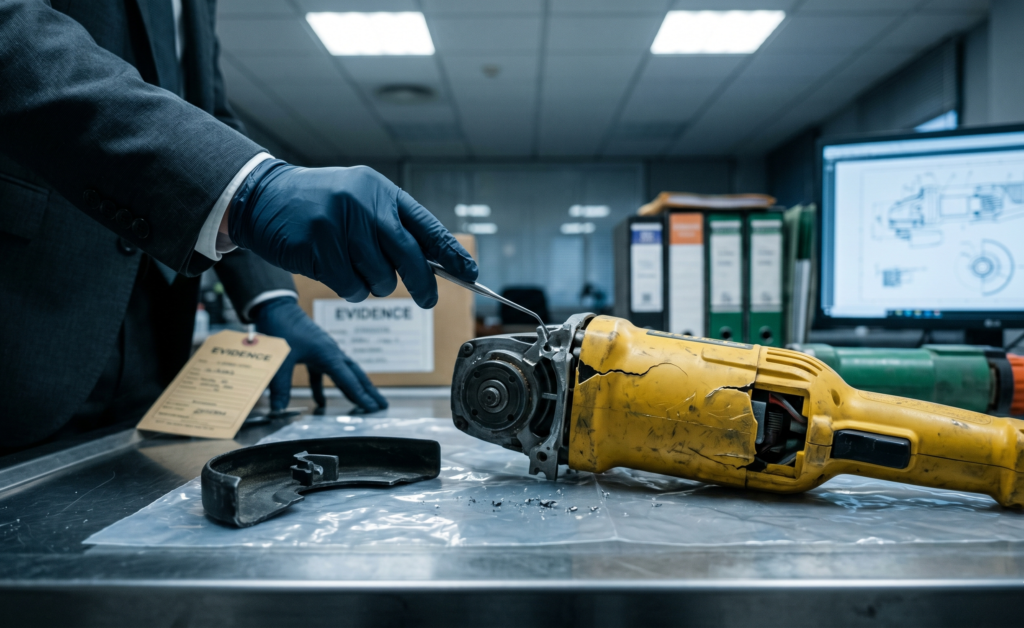
Insurer tactic to watch for: After a serious failure, the equipment is sometimes repaired, returned to the rental company, scrapped, or “cleaned up” before the defect is ever documented. Once that machine is gone, proving what failed becomes far harder. Attorneys often emphasize how decisive the first days after an injury can be, because the broken product itself is usually the single most important piece of evidence.
The Workers’ Comp Lien: Why the Two Claims Are Linked
There is one connection that surprises most workers. When a defective equipment lawsuit succeeds, the workers’ comp insurer that already paid your medical bills and wage benefits may be entitled to be repaid out of that recovery. This is known as a comp lien or subrogation interest.
This does not make the lawsuit pointless — far from it. It means the two cases generally have to be evaluated together rather than separately, because how the lien is handled can significantly affect what you ultimately keep. The way liens are calculated and reduced is highly state-specific, which is one of the main reasons these claims are rarely navigated alone.
Deadlines and State Rules That Can End a Case Early
This is where strong claims quietly die. A comp claim and a product liability claim run on completely different clocks. The deadline to report a comp injury may be measured in days, while the deadline to file a defective product claim — the statute of limitations — is generally measured in years. Missing either one is usually permanent.
State laws vary significantly. Filing deadlines, the rules on shared fault, the size of the comp lien, and even which companies in the supply chain can be held responsible change dramatically from one state to the next. In some states, fault assigned to the injured worker can reduce or eliminate recovery; in others, the rules are far more forgiving. Standard guidelines suggest confirming the specific deadlines that apply where the injury occurred, because a missed window generally cannot be reopened.
Approaches Injured Workers Commonly Consider
While nothing here is legal or medical advice, the following reflects how serious injuries involving suspect equipment are generally navigated. Attorneys often recommend treating documentation as the backbone of both claims:
- Preserving the equipment itself. Keeping the actual machine, tool, or part — unrepaired and unreturned — is widely regarded as the most valuable step, since the product is the core evidence.
- Photographing the failure point. Close images of the break, the missing guard, or the worn cable, taken before anything is altered, often carry significant weight.
- Recording the make, model, and serial number. These details identify exactly which manufacturer and which production run are involved.
- Acting within the deadlines. Because the clocks differ and state rules vary, understanding local time limits early is generally considered essential.
Remember: A construction injury can open two doors, not one. Workers’ comp handles the immediate medical and wage support, while a defective equipment lawsuit may hold the manufacturer accountable for everything comp leaves behind. State laws vary significantly, and the specific facts of your equipment always matter.
See What Your Claim May Truly Be Worth
If a comp check is barely covering your bills, it is worth knowing whether the company that built the equipment should be answering for what happened. A possible product liability claim often goes completely unexamined simply because no one tells the injured worker it exists. Before you assume workers’ comp is the end of the story, get a clearer picture of the potential value and direction of your situation. Try the free, anonymous Benefits Estimator at HardHat Rights — no names, no pressure, just a clearer sense of your options in minutes. Start your free Benefits Estimator here and find out what your next step could look like.
Disclaimer: This website is for informational purposes only and does not constitute legal or medical advice. The content provided is not intended to be a substitute for professional medical advice, diagnosis, or treatment. Benefit estimates are approximations based on standard state formulas and do not account for your state’s specific caps or your individual circumstances. Always consult a licensed workers’ compensation attorney in your state for legal advice, and a qualified health provider regarding any medical conditions or treatment.