Workers’ Comp Surveillance: Are Insurance Investigators Watching You?
If you have filed a workers’ compensation claim after a jobsite injury, there is a real possibility that someone you have never met is paying close attention to your daily movements. Surveillance is one of the most common — and least discussed — tools used by insurance carriers to dispute construction injury claims. It is rarely dramatic, and it is almost never announced. For an injured worker already dealing with pain, lost wages, and uncertainty, the idea of being watched can feel both invasive and frightening.
This guide explains, in plain terms, how workers’ comp surveillance generally works, why insurers use it, and what injured construction workers should understand about protecting the integrity of an honest claim.
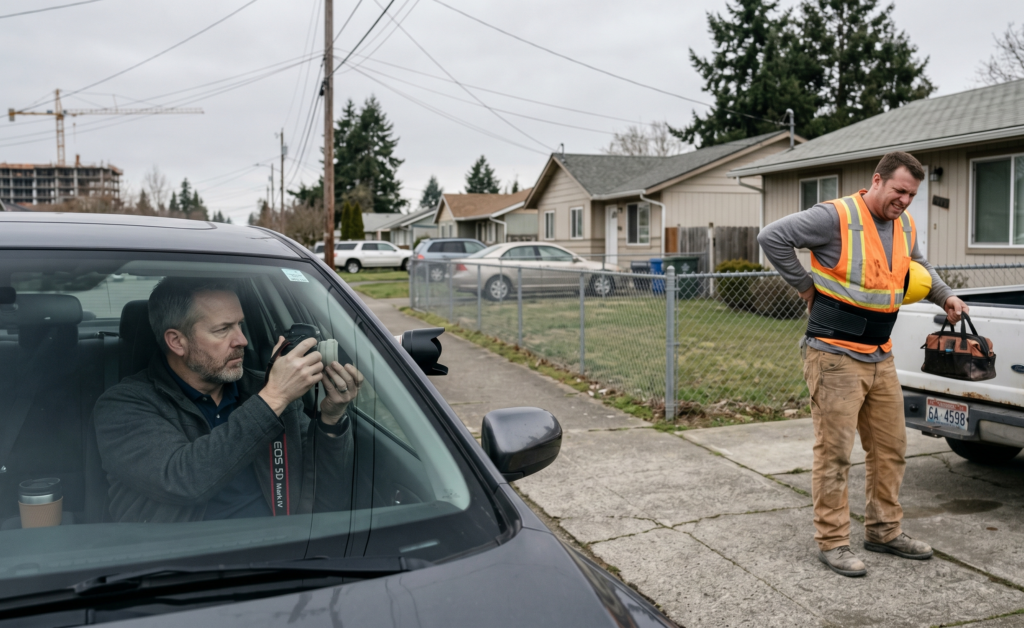
Why Would an Insurer Put You Under Surveillance?
Insurance carriers are businesses, and every approved claim is a cost on their books. Surveillance is generally used not to confirm that a worker is hurt, but to look for any moment that can be framed as inconsistent with the reported injury. In many cases, the goal is to build a file that creates doubt.
Investigators are typically assigned when a claim shows one or more of the following characteristics:
- High-value claims involving surgery, long-term disability, or permanent impairment.
- Soft-tissue or back injuries that do not always appear obvious on imaging.
- Claims where the worker is expected to be off the job for an extended period.
- Any perceived inconsistency between the injury described and the worker’s reported activity.
- Disputes over whether the injury is truly work-related.
Insider tactic: Carriers often schedule surveillance around medical appointments, independent medical exams (IMEs), and depositions — moments when they know exactly where you will be and when.
Common Surveillance Tactics Investigators Use
Surveillance in workers’ comp cases is generally broader than most people expect. It is not limited to a single person sitting in a parked car. Standard guidelines within the investigation industry typically include a mix of physical observation and digital research.
| Surveillance Type | What It Typically Involves |
|---|---|
| Physical surveillance | An investigator follows or films a claimant in public — running errands, leaving the house, lifting groceries, or doing yard work. |
| Video documentation | Long-lens recording from a public street, often capturing short clips that are later edited into a timeline. |
| Social media review | Examination of public posts, photos, check-ins, and tagged content across platforms. |
| Activity checks | Investigators may visit a worker’s neighborhood, gym, or even pose as someone making casual conversation. |
| Records research | Public databases, prior claims history, and online footprint used to build a profile. |
Social Media: The Surveillance You Hand Over Freely
For modern construction injury claims, social media has become the single easiest source of damaging material for an insurer. A photo posted to be polite — smiling at a family barbecue, holding a child, standing at a wedding — can be stripped of all context and presented as proof that an injury is exaggerated.
The danger is rarely about dishonesty. It is about how a single frozen image can be misread. A worker who pushed through severe pain for one ten-second photo may appear, on screen, to be perfectly fine.
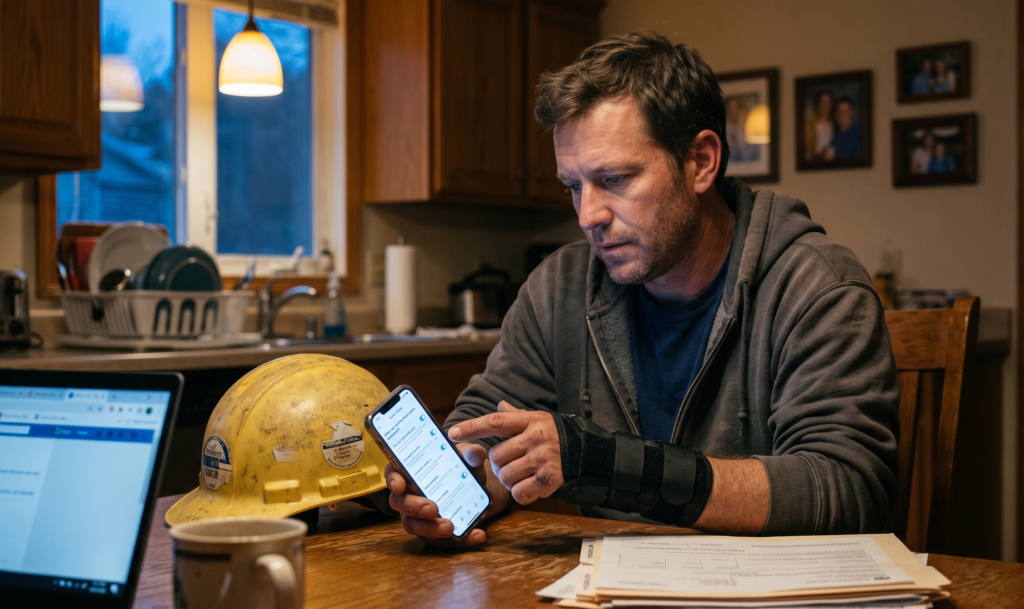
Generally, in many states, anything posted publicly online can be reviewed and potentially introduced as evidence. Attorneys often recommend that claimants treat their online presence as if a carrier is already watching — because, frequently, it is.
Is Workers’ Comp Surveillance Even Legal?
This is one of the most common questions injured workers ask, and the answer is generally yes — within limits. Investigators are typically permitted to observe and record a person in public spaces where there is no reasonable expectation of privacy. What they are generally not permitted to do is trespass onto private property, record inside your home, intercept private communications, or misrepresent themselves in ways that cross into harassment.
It is important to understand that state laws vary significantly regarding privacy, recording consent, and what surveillance evidence is admissible. The rules that apply in one state may be very different just across the border. Workers seeking the federal baseline on jobsite safety and worker protections can review official guidance published by the U.S. Occupational Safety and Health Administration (OSHA).
Warning: Because surveillance evidence is generally legal when gathered in public, the strongest protection an honest claimant has is consistency — making sure that what is reported to a doctor matches real, day-to-day physical limits.
How Honest Workers Get Misrepresented
The most damaging surveillance is rarely a “gotcha” moment. More often, it is the “snapshot” trick: an investigator captures a few seconds of normal movement and presents it as if it represents the worker’s entire condition.
- A worker reports being unable to perform heavy lifting on a jobsite.
- Footage shows that same worker briefly carrying a light bag of groceries.
- The carrier argues the two are contradictory — even though they are not medically comparable.
This is why detailed, honest medical documentation matters so much. For a full breakdown of how to keep an injury claim consistent and protected from these tactics, our complete workers’ compensation guide walks through each stage of the process.
Signs You May Be Under Surveillance
Surveillance is designed to be invisible, but injured workers sometimes notice subtle patterns. While none of these confirm anything on their own, they are commonly reported:
- The same unfamiliar vehicle parked near your home on multiple days.
- A stranger who seems to appear at locations tied to your appointments.
- Unusual friend requests or messages from accounts you do not recognize.
- A sudden increase in carrier questions about your daily activities.
Generally, the most reassuring fact for an honest claimant is simple: surveillance only becomes a problem when there is a gap between what is reported and what is true. Accurate, consistent reporting is the strongest defense.
Find Out What Your Construction Injury Claim Could Be Worth
Understanding whether you are being watched is only one piece of protecting your rights. The next step is knowing the real potential value of your workers’ comp claim — before a carrier tries to define it for you.
You can use our free, anonymous Benefits Estimator at HardHat Rights to get a confidential, no-pressure estimate of what your construction injury claim may be worth. It takes only a few minutes, requires no personal contact information to begin, and helps you walk into your claim informed instead of outmatched.
HardHat Rights provides general information for educational purposes and is not a substitute for advice from a licensed attorney in your state. Because workers’ compensation laws differ significantly from state to state, individual cases may vary.
Disclaimer: This website is for informational purposes only and does not constitute legal or medical advice. The content provided is not intended to be a substitute for professional medical advice, diagnosis, or treatment. Benefit estimates are approximations based on standard state formulas and do not account for your state’s specific caps or your individual circumstances. Always consult a licensed workers’ compensation attorney in your state for legal advice, and a qualified health provider regarding any medical conditions or treatment.